
Reverse osmosis (RO) membranes remove dissolved salts and other contaminants from water, but suspended particles, organic matter, biological deposits, and mineral scale can gradually reduce their performance. Effective cleaning helps restore permeate flow, control pressure losses, and maintain system efficiency.
To clean an RO membrane effectively, operators must identify the cause of performance deterioration, select a compatible cleaning chemical, and follow the correct cleaning procedure. For industrial systems, clean-in-place (CIP) cleaning enables chemical cleaning without removing membrane elements from their pressure vessels.
This guide covers when to clean reverse osmosis membranes, how to identify fouling, how to select cleaning chemicals, and how to evaluate performance after cleaning.
When Should You Clean Reverse Osmosis Membranes?
RO membranes should be cleaned when operating data indicates significant fouling or scaling, rather than according to a fixed schedule alone. Delayed cleaning can make deposits harder to remove, while unnecessary chemical treatment increases costs and may shorten membrane service life.
Common Signs of RO Membrane Fouling
Monitor three key indicators: normalized permeate flow, normalized salt passage, and differential pressure across the membrane stage. Normalization accounts for changes in operating conditions, helping distinguish actual membrane deterioration from variations in temperature, pressure, salinity, or recovery.
Common warning signs include:
- Reduced normalized permeate flow: Water production declines under comparable operating conditions.
- Increased normalized salt passage: More dissolved salts pass into the permeate, potentially indicating fouling or membrane damage.
- Higher differential pressure: Deposits restrict flow through the feed channels.
- Increased energy demand: More pressure may be needed to maintain the target production rate.
These symptoms do not automatically justify chemical cleaning. Check feed-water quality, instruments, and system operation to identify the underlying cause first.
When to Clean an Industrial RO Membrane
Follow the membrane manufacturer’s cleaning criteria and the plant’s operating procedures. Common screening guidelines include a 10–15% decrease in normalized permeate flow, a 5–10% increase in normalized salt passage, or a 10–15% rise in stage differential pressure relative to the established baseline. These are general guidelines, not universal limits.
Early investigation is important because severe or prolonged fouling may be more difficult to reverse. A sudden performance decline may also indicate equipment malfunction or membrane damage rather than gradual fouling.
Quick RO Membrane Cleaning Decision Guide
Use the following guide to determine the next step when RO membrane performance declines:
|
Observed Condition |
Recommended Action |
|
Normalized permeate flow decreases, normalized salt passage increases, or stage differential pressure rises beyond the established baseline |
Verify operating data and investigate whether fouling or scaling is responsible. |
|
Suspended solids or colloidal deposits are suspected |
Check pretreatment performance and assess whether particulate fouling requires cleaning. |
|
Organic deposits or biofilm are suspected |
Evaluate the feed-water conditions and select a compatible cleaning approach for the identified foulant. |
|
Mineral scale is suspected |
Review feed-water chemistry, recovery, and scaling potential before selecting a suitable cleaning chemical. |
|
Performance declines suddenly or salt passage remains unusually high |
Check for instrument, operating, seal, or membrane damage issues before assuming chemical cleaning will solve the problem. |
|
Fouling is confirmed and the membrane is compatible with the proposed treatment |
Follow the manufacturer’s approved RO membrane cleaning procedure, then evaluate normalized performance after cleaning. |
Important: Do not select a cleaning chemical based on symptoms alone. Cleaning thresholds, chemical compatibility, pH, temperature, concentration, and contact time must follow the membrane manufacturer’s instructions. If the cause of performance loss is unclear, investigate further before starting CIP cleaning.
Identify the Type of RO Membrane Fouling
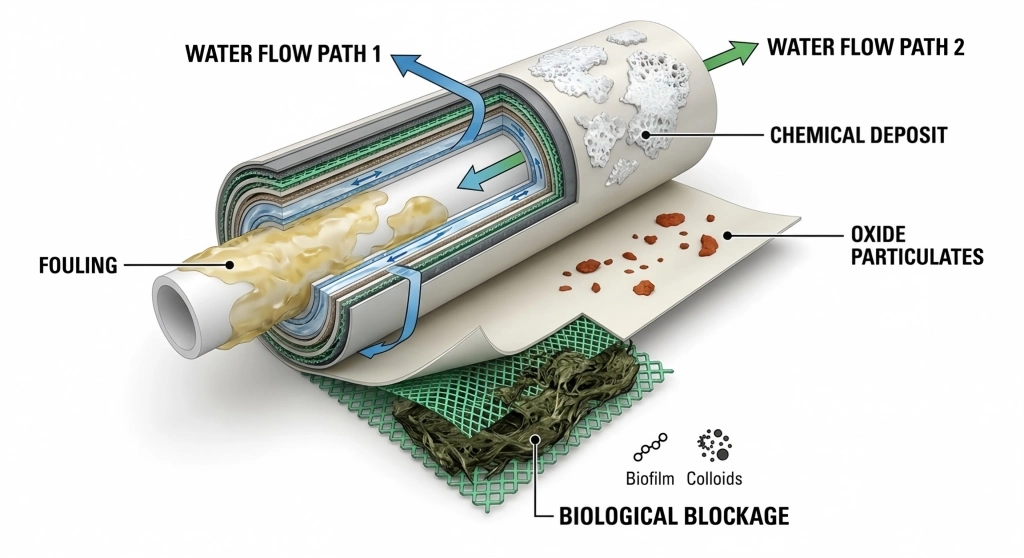
Choosing the right RO membrane cleaning chemical depends on the deposit type. Particulate fouling, organic deposits, biological growth, and mineral scaling may require different cleaning approaches.
Particulate and Colloidal Fouling
Suspended solids, fine particles, and colloids can accumulate on membrane surfaces and within feed channels, particularly when filtration or other pretreatment processes perform poorly. Common signs include reduced permeate flow and increased differential pressure. Cleaning may remove accumulated deposits, but pretreatment problems must also be corrected to prevent recurrence.
Organic Fouling and Biofouling
Natural organic matter, oils, and other organic compounds can accumulate on membrane surfaces, while microorganisms may form biofilms within feed channels. These deposits restrict flow and can increase pressure losses. Alkaline cleaning is commonly used for many organic foulants, but the appropriate formulation depends on deposit composition and membrane compatibility. Biofouling prevention also requires effective pretreatment and microbial control.
Mineral Scaling
RO membrane scaling occurs when dissolved minerals precipitate as water becomes concentrated during separation. Common deposits include calcium carbonate, calcium sulfate, and certain silica-containing compounds. Scaling risk depends on feed-water chemistry, recovery, temperature, and pH.
Acidic cleaning may remove certain acid-soluble deposits, but not all scales respond effectively to acid. Some silica and sulfate deposits are particularly difficult to remove, making accurate identification and prevention essential.
Why Fouling Identification Matters
Similar operating symptoms can result from different problems, so cleaning chemicals should not be selected based on pressure or flow changes alone. Review feed-water analysis, pretreatment performance, operating history, and recovery settings. If the deposit type is uncertain, consult the membrane supplier before choosing a treatment.
Choose the Right RO Membrane Cleaning Chemical
An appropriate RO membrane cleaning chemical should target the deposit while remaining compatible with the membrane element and system components.
Alkaline Cleaning for Organic Fouling
Alkaline formulations are commonly used to remove many organic deposits and some biological foulants by loosening or dispersing accumulated material. Their effectiveness depends on the contaminant and cleaning formulation; stronger solutions or longer exposure times do not necessarily produce better results.
Acid Cleaning for Mineral Scaling
Acidic solutions can dissolve certain inorganic deposits, particularly acid-soluble carbonate scales. However, some mineral deposits respond poorly to acid, and unsuitable chemicals can damage membrane elements or system components. Select the cleaning agent according to the identified scale and manufacturer guidance.
How to Select Compatible Cleaning Chemicals
Before cleaning, confirm the deposit type, membrane compatibility, permitted concentration, pH, temperature, contact time, and compatibility with the cleaning equipment. Establish appropriate procedures for handling and disposing of spent solution.
Never mix acidic and alkaline chemicals directly. If sequential cleaning stages are required, follow the approved procedure for draining and rinsing between stages. Always use the chemical and operating limits specified for the particular membrane element.
RO Membrane Cleaning Procedure: Step by Step
The following steps provide a general guide for how to clean industrial RO membranes using a dedicated cleaning system. Exact chemical formulations, flow rates, pressures, temperatures, pH values, and contact times must follow the membrane manufacturer’s instructions.
Step 1 — Review Operating Data and Confirm the Cleaning Need
Record normalized permeate flow, normalized salt passage, and stage differential pressure. Check feed-water quality and investigate possible mechanical or chemical damage before proceeding.
Step 2 — Prepare the Cleaning System
Isolate the RO system according to site procedures. Inspect the cleaning tank, circulation pump, valves, cartridge filter, valves, and pipework, confirming that all components are clean and chemically compatible.
Step 3 — Prepare the Cleaning Solution
Prepare the approved solution using the specified chemical and water quality. Verify concentration and pH, and monitor temperature where required. Keep different cleaning solutions separate unless the approved procedure specifies otherwise.
Step 4 — Recirculate and Soak
Circulate the solution through the designated membrane stage at the prescribed flow and pressure. Use a soaking period only when required by the cleaning procedure, and remain within the specified operating limits.
Step 5 — Flush and Rinse the System
Drain the spent solution safely and flush the system with suitable water until residual chemicals are removed according to the manufacturer’s instructions. Verify rinse-water pH or conductivity when required.
Step 6 — Restart and Evaluate Performance
Restart the system gradually and monitor permeate flow, conductivity, and differential pressure as operating conditions stabilize. Compare normalized performance with the pre-cleaning baseline and document the results.
Understanding the CIP Cleaning Process for RO Membranes
What Is Clean-in-Place (CIP) Cleaning?
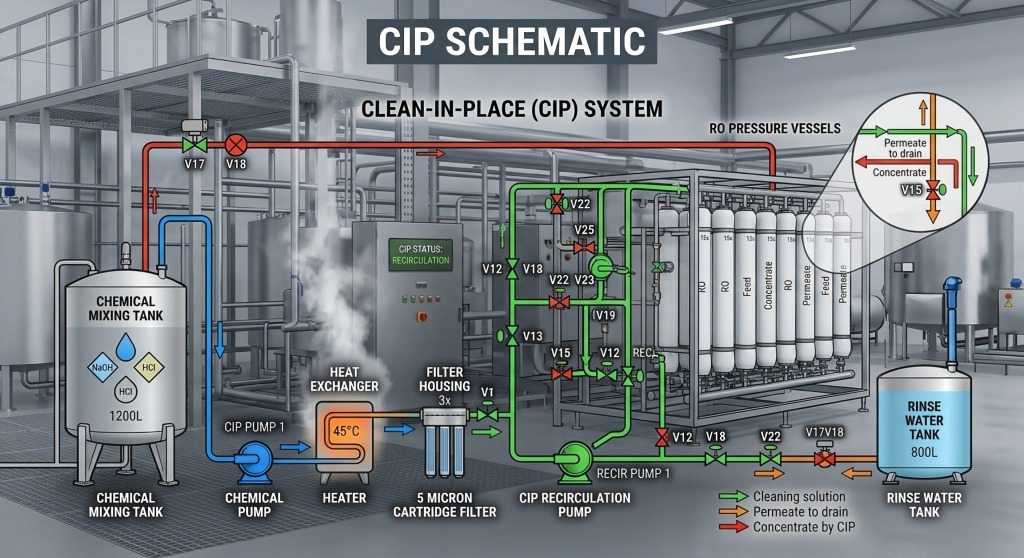
CIP cleaning allows membrane elements to be chemically cleaned while remaining installed in their pressure vessels. A typical system includes a cleaning tank, circulation pump, filtration components, and connecting pipework. It provides controlled delivery of the cleaning solution without requiring routine removal of individual elements.
Key Stages of the RO Membrane CIP Process
The membrane CIP process generally consists of system preparation, cleaning-solution circulation, soaking when required, rinsing, and performance verification. Large industrial systems may require individual membrane stages to be cleaned separately because fouling severity can vary throughout the installation.
Common CIP Cleaning Mistakes to Avoid
Avoid incompatible chemicals, excessive pressure, temperatures or pH outside permitted limits, and inadequate rinsing. Repeating CIP without diagnosing the cause may also waste chemicals and time. Cleaning cannot repair membrane oxidation, mechanical damage, or other irreversible deterioration.
How to Restore RO Membrane Performance After Cleaning
Compare Normalized Performance Before and After Cleaning
Compare normalized permeate flow, normalized salt passage, and differential pressure under comparable conditions. Improved flow and lower differential pressure may indicate successful deposit removal, while persistently high salt passage may signal membrane damage, oxidation, or seal leakage.
What If Cleaning Does Not Restore Performance?
If performance remains poor, review the original fouling diagnosis, cleaning conditions, and feed-water chemistry. Difficult-to-remove deposits, irreversible fouling, membrane aging, and physical or chemical damage may require specialist assessment rather than another identical cleaning cycle.
Prevent Recurring Fouling and Scaling
Maintain effective pretreatment, monitor feed-water quality, and manage suspended solids, organic loading, biological activity, and scale-forming constituents. Review recovery settings and pretreatment controls, including antiscalant use where appropriate. Consistent operating records help identify developing problems and schedule cleaning according to actual membrane condition.
Conclusion: Keep Your RO Membranes Performing Efficiently
Effective RO membrane cleaning starts with identifying the cause of performance deterioration and selecting a compatible cleaning method. Monitoring normalized operating data, following the correct cleaning procedure, and evaluating results after CIP can help control fouling and maintain reliable water-treatment performance.
Proper pretreatment and preventive maintenance remain essential to reducing recurring fouling and scaling. For industrial RO membrane solutions, JOZZON can help you evaluate membrane options based on your feed-water conditions and treatment requirements. Contact the JOZZON team to discuss your application.


