1. Introduction
Chemical cleaning is a method that uses various complex reactions between chemical substances to soften and dissolve the contaminant layer on the membrane surface, ultimately cleaning it thoroughly.
(1) When using any chemicals for cleaning, safe operating procedures must be followed. Consult the manufacturer for details regarding the basic properties of the chemicals, their usage, and storage and disposal.
(2) Ensure that all chemicals are completely dissolved and mixed before the cleaning solution enters the system circulation.
(3) After system cleaning, the membrane elements should be thoroughly rinsed with reverse osmosis grade clean water. To ensure the rinsing effect, rinsing should be carried out under low pressure and high flow conditions, and the rinsing water temperature should be >20ºC. The concentrate and product water effluent must be discharged until the product water is clear.
(4) During the circulation of the cleaning solution, the temperature should not exceed 50ºC when the system ph is 2 to 10, should not exceed 35ºC when the ph is 1 to 11, and should not exceed 30ºC when the ph is 1 to 12.
(5) The direction of the cleaning fluid flow must be the same as the normal operating direction to prevent the components from developing a “telescope” phenomenon.
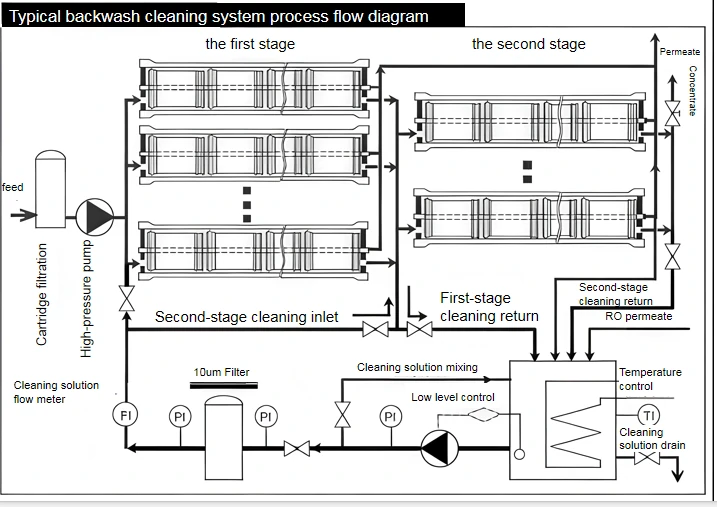
Typical cleaning process flow
2. Cleaning Equipment
The equipment required for cleaning generally includes: filters, circulating pumps, cleaning water tanks, pressure gauges, thermometers, valves, pipelines, etc. When selecting each piece of equipment, key factors such as instantaneous maximum pressure, maximum flow rate, strongest corrosiveness, and maximum water storage capacity must be considered.
3. Cleaning Steps
Clean the membrane element using the following steps:
(1) Prepare a suitable cleaning solution.
(2) Slowly introduce the cleaning solution. Replace the raw water in the element with the cleaning solution at the lowest possible pressure, just enough to pass the raw water through the reverse osmosis membrane.
(3) The system operates in a circulating manner. After the raw water is replaced, cleaning fluid appears in the concentrate pipeline, which is then circulated back to the water tank and the temperature of the cleaning fluid is kept constant.
(4) Stop and soak. Stop the water pump and completely immerse the membrane element in the cleaning solution. The soaking time depends on the stubbornness of the contaminants, and the temperature must be maintained during the process.
(5) High-speed circulation operation. High flow rate can flush away contaminants washed away by the cleaning fluid. Under high flow rate conditions, the pressure drop will increase. The maximum allowable pressure drop for a single membrane element is 15 psi.
(6) Flushing and Discharge. Use qualified produced water to flush the cleaning solution in the system. Make sure to rinse the cleaning solution completely and discharge all the water. Do not let it flow back into the system.
Precautions:
- During alkaline or acidic washing, the ph value of the cleaning solution should be monitored at all times. When the ph value changes by more than 0.5 (0.5 decrease for alkaline washing and 0.5 increase for acidic washing), alkali or acid should be added to the cleaning tank in time to maintain a stable ph value and ensure the cleaning effect.
- Before cleaning a large system, it is recommended to remove a membrane element from the system to be cleaned and conduct a unit cleaning test to determine the specific contaminants or cleaning effect, which will help to clean the large system more efficiently.
4. Cleaning agents
Different cleaning agents should be used for different contaminants. Chemical cleaning is generally divided into two main categories: acidic and alkaline cleaning agents. Acidic cleaning agents are used to remove inorganic contaminants, including iron stains, or metal oxides, while alkaline cleaning agents are used to remove organic contaminants, including microorganisms. The ph of acidic cleaning is approximately 2, and the ph of alkaline cleaning is approximately 12. Sometimes these two cleaning methods need to be used in combination; sometimes surfactants are added, and sometimes a small amount of flocculant is added.
Table 7.1 General Cleaning Agents for Reverse Osmosis Membrane Elements
|
Cleaning solution pollutants |
0.1 wt%NaOH or 1.0 wt%Na4 EDTA [ph 12/30℃ (maximum)] |
0.1 wt% NaOH or 0.025 wt% Na-SDS [ph 12/30℃ (maximum)] |
0.2 wt% HCl |
1.0 wt% Na₂S₂O₄ |
0.5 wt% H3PO4 |
1.0 wt% NH₂SO₃H |
2.0 wt% Citric acid |
|
Inorganic salt scale (e.g., CaCO3 ) |
|
|
Most |
Can |
Can |
|
Can |
|
Sulfates ( CaSO4 , BaSO4 ) |
Most |
Can |
|
|
|
|
|
|
Metal oxides (Like iron) |
|
|
|
Most |
Can |
Can |
Can |
|
Inorganic colloids (silt) |
|
Most |
|
|
|
|
|
|
Silicon |
Can |
Most |
|
|
|
|
|
|
Microbial film |
Can |
Most |
|
|
|
|
|
|
Organic matter |
First step of cleaning Can |
First step of cleaning most |
It is best to perform a second cleaning step. |
|
|
|
|
Note:
1. Wt indicates the weight percentage of the active ingredient;
2.The chemical symbols of the pollutants represent: CaCO3 for calcium carbonate; CaSO4 for calcium sulfate; and BaSO4 for barium sulfate.
For cleaning chemicals represent the following: NaOH represents sodium hydroxide; Na₄EDTA represents tetrasodium ethylenediaminetetraacetate; Na-SDS represents sodium dodecylbenzenesulfonate, also known as sodium laurate; HCl represents hydrochloric acid; Na₂S₂O₄ represents sodium bisulfite ; H₃PO₄ represents phosphoric acid ; and NH₄HSO₃ represents ammonium bisulfite.