Ultrafiltration Membrane Modules
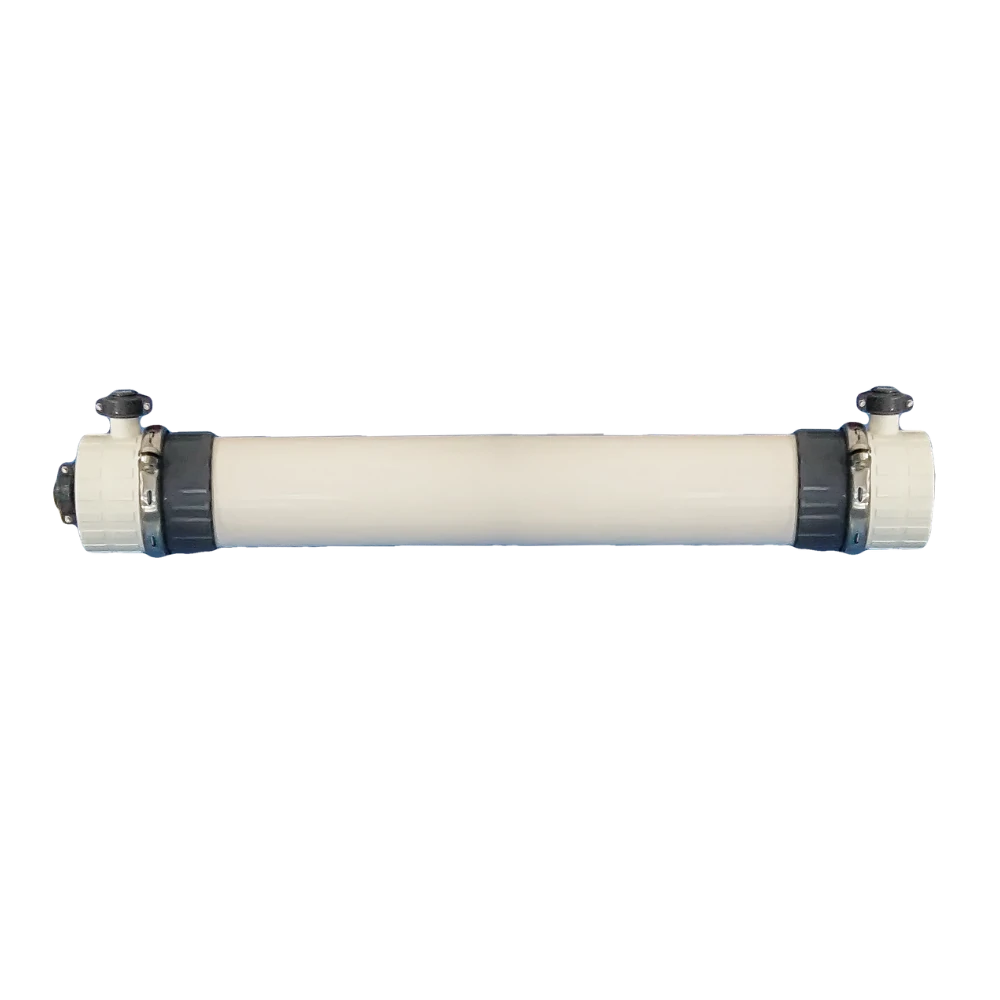
JOZZON’s hollow fiber ultrafiltration membrane modules use polyvinylidene fluoride (PVDF) and polyethersulfone (PES) as primary membrane materials. Designed for low-pressure operation and high water flux, these UF membrane modules provide stable filtration performance across a broad range of water treatment conditions.
With hydrophilic modification, tapered-pore architecture, and controlled membrane pore formation, JOZZON UF membrane modules offer strong chemical resistance, improved fouling resistance, and effective recovery through backwashing and chemical cleaning.
They are particularly suitable for pretreatment of large reverse osmosis systems, as well as municipal water treatment, wastewater reuse, industrial water treatment, and selected food, beverage, and pharmaceutical applications.
Hollow Fiber UF Membrane Modules for Advanced Water Treatment
JOZZON’s Ultrafiltration Membrane Modules are hollow fiber UF membrane modules manufactured primarily from polyvinylidene fluoride (PVDF) and polyethersulfone (PES).
The membranes incorporate hydrophilic modification and a three-dimensional tapered-pore architecture designed to improve surface characteristics, fouling resistance, and cleaning performance. The controlled pore structure provides a uniform membrane surface while supporting effective removal of suspended solids and other particulate contaminants.
The UF membrane modules feature ultra-low operating pressure and high water flux, making them suitable for continuous water treatment applications where stable production and efficient filtration are required.
Their broad water-quality applicability allows them to be used across municipal, industrial, wastewater reuse, and process-water applications. In particular, JOZZON UF membrane modules can serve as an effective pretreatment barrier for large reverse osmosis systems, helping protect downstream RO membranes from suspended solids and other particulate contaminants.
Applied Industries
Advanced treatment of tap water
Engineered for secure sterile purification supply loops within large municipal networks.
Turbidity and bacterial removal
Highly optimized extraction targeting surface water, deep groundwater, and fluctuating well source matrices.
Replacement of traditional filtration
Acts as an absolute structural upgrade path away from high-footprint multimedia and carbon tower filtration beds.
Pretreatment for reverse osmosis
Provides critical mechanical armor layers upstream protecting complex reverse osmosis elements from premature degradation.
Removal of particles and suspended solids
Captures downstream particulate slips or fragments not fully eliminated during ion exchange resin treatment runs.
Turbidity reduction and sterilization
Delivers refined, micro-biologically compliant process water loops specialized for food processing and medical application boundaries.
Reuse of secondary treated wastewater
Achieves deep structural recycle performance for municipal or domestic sewage streams meeting GB8978-2012 Class II benchmarks.
Treatment of high-suspension wastewater
Provides continuous solid-stripping across coal storage yard runoffs and deep clarification of industrial oilfield reinjection water.
Protein and beverage refinement
Enables structural molecular concentration of amino fractions, heavy juice refinement loops, and commercial wine clarification.
Clarification of medicine extracts
Provides sharp chemical separation and solid extraction for complex traditional Chinese medicine fluid formulations.
Filtration for residential water systems
Engineered to supply ultra-pure community or institutional multi-housing block utility drinking loops.
Treatment of landfill leachate
Robustly handles aggressive organic and biological mass blocks embedded in deep landfill chemical tailing streams.
Features & Benefit
1.Exceptional Chemical Resistance (Premium PVDF)
Utilizing polyvinylidene fluoride (PVDF) membrane material with exceptional chemical resistance enables the membrane elements to withstand cleaning with acids, alkalis, oxidizing agents, and other chemicals. Figure 1 illustrates the chemical resistance of commonly used sodium hypochlorite solution, illustrating the chemical resistance of common ultrafiltration membrane materials. Under identical conditions, PVDF exhibits the highest chemical resistance.
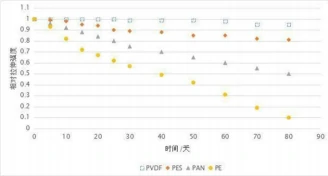
Figure 1: Change in relative tensile strength after 1500 ppm sodium hypochlorite treatment
2.Hydrophilic Surface Modification
Hydrophilic material modification reduces the contact angle (as shown in Figure 2), enhancing the membrane surface’s resistance to contaminant adsorption while facilitating easier cleaning of adhered contaminants.
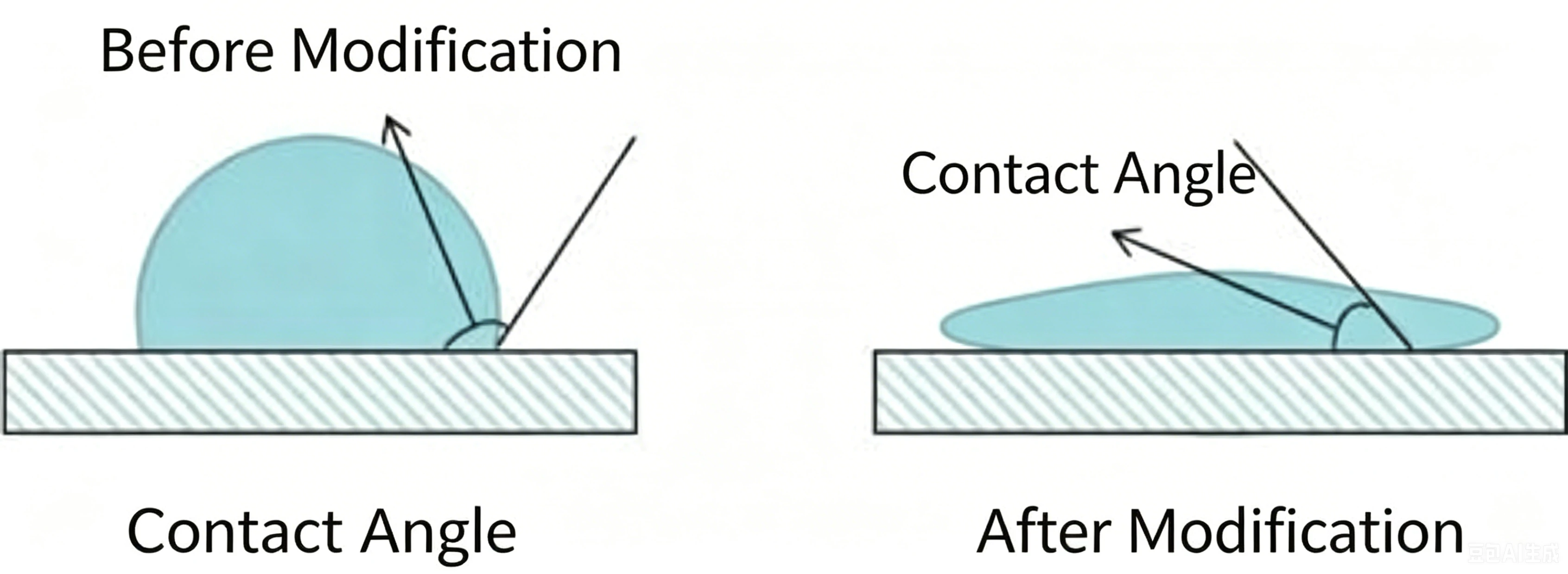
Figure 2: Contact angle variation before and after hydrophilic modification
3.Three-Dimensional Cone Pore Architecture
PU modification endows the membrane with pressure-responsive functionality, imparting excellent mechanical properties (strong tensile properties). During backwashing and chemical cleaning, the pore size slightly expands, facilitating easier removal of blockages and contributing to improved high backwash and chemical cleaning recovery rates can exceed 99%.
The “three-dimensional cone” pore formation technology creates a “cone-shaped hopper” structure within the membrane filament (as shown in Figure 3, right), which also enhances backwashing and chemical cleaning performance, boosting the regeneration recovery rate of ultrafiltration membranes. Additionally, JOZZON employs advanced membrane formation processes to achieve a uniform pore size distribution in the skin layer structure. This results in a smooth membrane surface, enhancing the membrane’s resistance to fouling. Figure 3 (left) shows an electron microscope image of the ultrafiltration membrane’s dense layer, where the pore size and distribution are uniform.
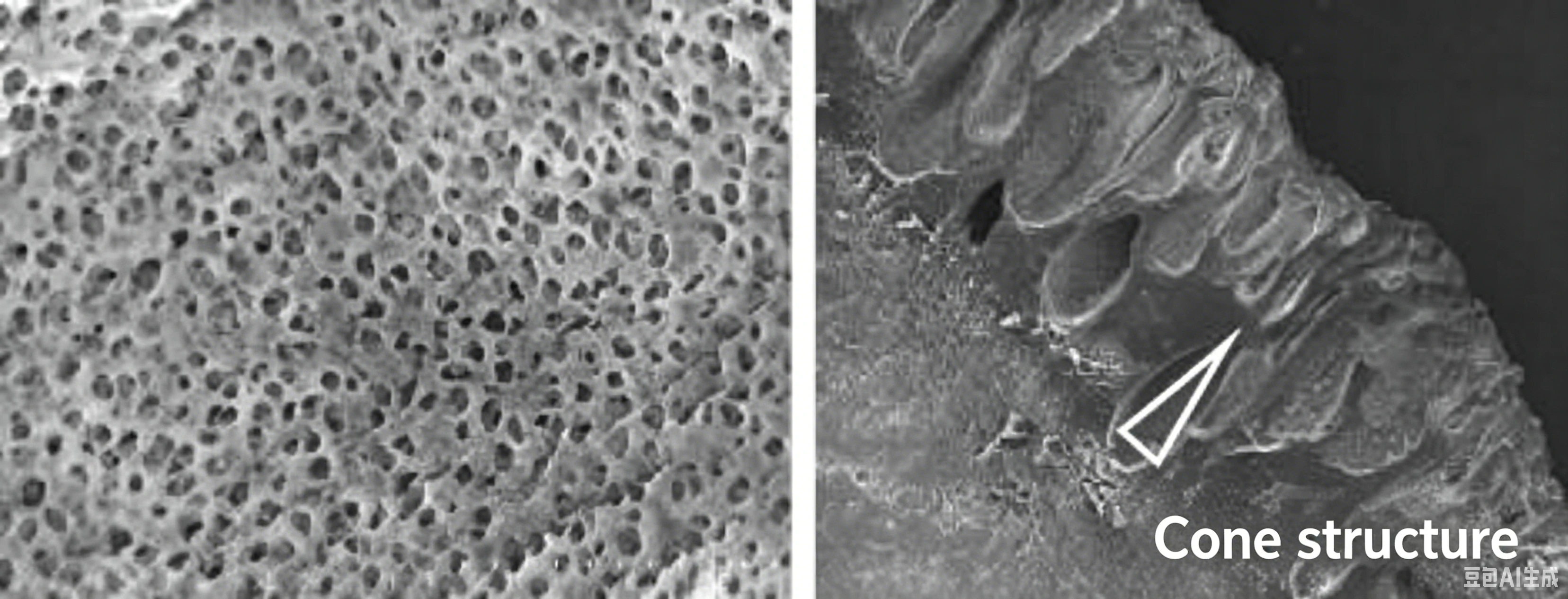
Figure 3: Ultrafiltration membrane surface (left) and cross-section (right)
A unique pore expansion and pore stabilization post-treatment process further refines the membrane surface, making it smoother and less prone to contaminant adhesion.
Ultrafiltration Membrane Module Model
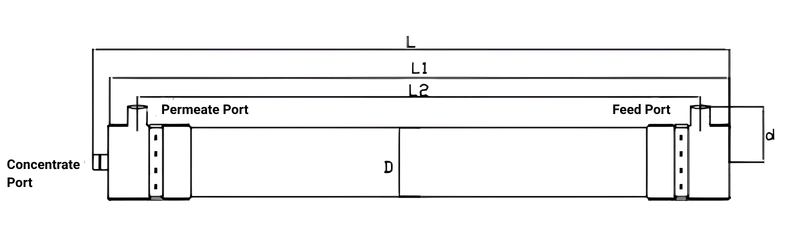
End-Cap External Pressure Membrane Module Dimensions Table 1
|
Model |
Membrane Area Area m² |
Water-filled Weight kg |
D (mm) |
L (mm) |
L1 (mm) |
L2 (mm) |
d(mm) |
Inlet |
Product Outlet |
Concentrate Outlet |
|---|---|---|---|---|---|---|---|---|---|---|
|
JUF-225-52 |
52 |
85 |
225 |
1860 |
1810 |
1620 |
180 |
DN50 |
DN50 |
DN50 |
|
JUF-225-60 |
60 |
92 |
250 |
1710 |
1680 |
1600 |
172 |
DN50 |
DN50 |
DN50 |
|
JUF-225-70 |
70 |
96 |
216 |
2360 |
2320 |
2160 |
180 |
DN50 |
DN50 |
DN50 |
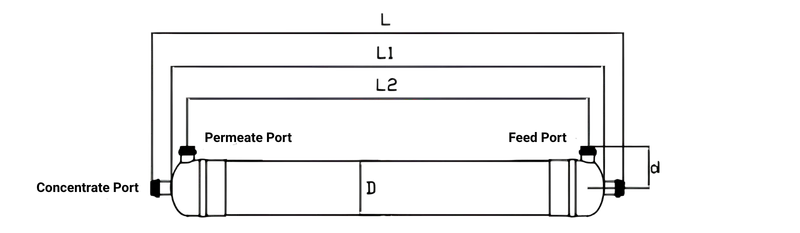

Elliptical End Cap External Pressure Membrane Module Dimensions Table 2
|
Model |
Membrane Area m² |
Water-filled Post-Weight kg |
D (mm) |
L (mm) |
L1 (mm) |
L2 (mm) |
D (mm) |
Inlet |
Product Outlet |
Concentrate Outlet |
|---|---|---|---|---|---|---|---|---|---|---|
|
JUF-225-33 |
33 |
33 |
165 |
1860 |
1710 |
1610 |
125 |
DN32 |
DN32 |
DN32 |
|
JUF-225-41 |
41 |
38 |
160 |
1730 |
1656 |
1386 |
130 |
DN40 |
DN40 |
DN40 |
|
JUF-225-50 |
50 |
50 |
165 |
2418 |
2209 |
1990 |
150 |
DN40 |
DN40 |
DN40 |
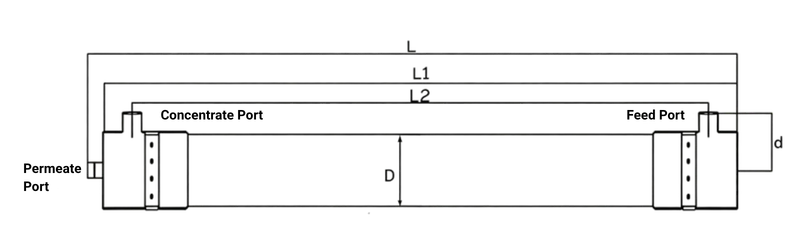
Cover Internal Pressure Membrane Module External Dimensions Table 3
|
Model |
Membrane Area m² |
Water-filled Weight kg |
D (mm) |
L (mm) |
L1 (mm) |
L2 (mm) |
D (mm) |
Inlet |
Product Outlet |
Concentrate Outlet |
|---|---|---|---|---|---|---|---|---|---|---|
|
JUF-220-50 |
50 |
62 |
225 |
1708 |
1680 |
1600 |
160 |
DN50 |
DN50 |
DN50 |
|
JUF-220-50S |
50 |
64 |
250 |
1715 |
1680 |
1600 |
172 |
DN50 |
DN50 |
DN50 |
|
JUF-220-55 |
55 |
42 |
225 |
1902 |
1795 |
1740 |
160 |
DN50 |
DN50 |
DN50 |
|
JUF-220-60 |
60 |
89 |
250 |
2215 |
2180 |
2100 |
172 |
DN50 |
DN50 |
DN50 |
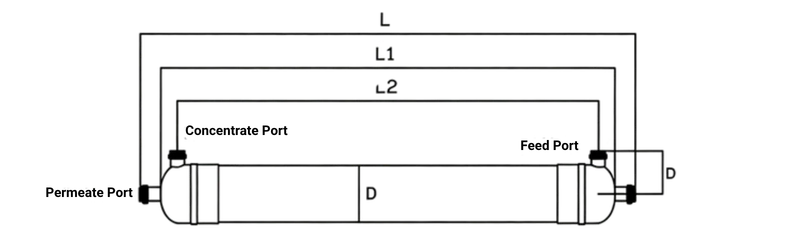
Circular End Cap Internal Pressure Membrane Module External Dimensions Table 4
|
Model |
Membrane Area m² |
Water-filled Weight kg |
D (mm) |
L (mm) |
L1 (mm) |
L2 (mm) |
D (mm) |
Inlet |
Product Outlet |
Concentrate Outlet |
|---|---|---|---|---|---|---|---|---|---|---|
|
JUF-221-13 |
13 |
5.6 |
125 |
1092 |
954 |
845 |
130 |
DN25 |
DN25 |
DN25 |
|
JUF-221-20 |
20 |
36 |
160 |
1730 |
1656 |
1386 |
130 |
DN40 |
DN40 |
DN40 |
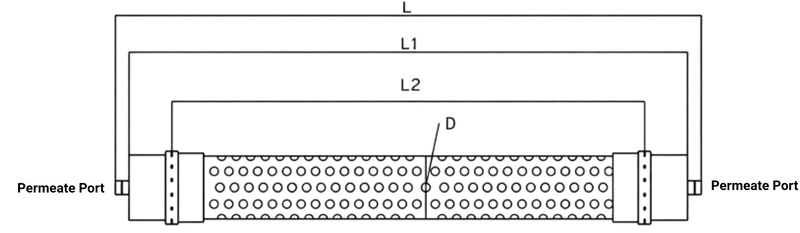
Immersion Membrane Module External Dimensions Table 5
|
Model |
Membrane Area m² |
D(mm) |
L(mm) |
L1(mm) |
L2(mm) |
Inlet |
Product Outlet |
Concentrate Outlet |
|---|---|---|---|---|---|---|---|---|
|
JUF-3225S |
25 |
125 |
1860 |
1820 |
1500 |
DN50 |
DN50 |
DN50 |
|
JUF-3250S |
50 |
225 |
1860 |
1820 |
1500 |
DN50 |
DN50 |
DN50 |
|
JUF-3265S |
65 |
250 |
1860 |
1820 |
1500 |
DN50 |
DN50 |
DN50 |
Engineering & Operation Requirements
| Item | Technical Specifications & Implementation Directives |
|---|---|
| 1 | Feedwater Source Requirements:Tap water, groundwater(Surface water, seawater, or wastewater meeting National Grade IIGB8978-2012discharge standards),Wastewater meeting national Class II discharge standards. |
| 2 | Ensure no mechanically abraded particles in feedwater, with maximum particle size ≤150μm and TSS ≤100ppm. |
| 3 | Total iron content in feedwater ≤0.5mg/L, manganese content ≤0.3mg/L, oil content <1mg/L. If any indicator exceeds these limits,pretreatment must be performed first. |
| 4 | Recommended ultrafiltration membrane system design recovery rate ≥90%. |
| 5 | Operating Pressure:External Feed Pressure 0.05~0.25 MPa Internal Feed Pressure 0.05~0.3 MPa. |
| 6 | Transmembrane pressure difference ≤0.1 MPa (recommended range: 0.05–0.1 MPa). |
| 7 | Backwash cycle: Recommended duration is 20–60 minutes per cycle. Adjust the backwash cycle based on feed water quality. Add acids, alkalis, and biocides to the backwash solution as recommended. Backwash water quality must use membrane module post-filtration water from the membrane assembly. |
| 8 | Water backwash pressure ≤0.2 MPa (recommended 0.1–0.15 MPa). |
| 9 | For online air-water dual washing: – Recommended backwash water flow: 120–150 L/m²·h – Recommended backwash time: 20–60 seconds. |
| 10 | For online air-water dual washing: – Recommended air consumption: 40–75 L/(h·m²) – Inlet air pressure: 0.05–0.1 MPa. |
| 11 | When backwashing with water alone, recommended backwash flow rate: 130–180 L/m²/h; backwash duration: 40–90 seconds. |
| 12 | Design flux for ultrafiltration membrane modules: For both internal and external pressure modules, recommended design flux: 50–120 L/m²/h. For submerged ultrafiltration membrane modules, the recommended design flux is: 15–50 L/m²/h. |
| 13 | Operating temperature range: 5–45°C. |
| 14 | Feed water ph range: 2–10. |
| 15 | Transmembrane pressure difference ≥ 0.1 MPa; Water production reduction from design value: 10–15%; When water production pressure remains constant and inlet increases by 10-20% above design values, chemical cleaning is recommended. |
🚨 Special Note
- Strictly prohibit particles larger than 150μm in the feed water.
- Strictly prohibit operation exceeding the rated pressure.
- Strictly prohibit a transmembrane pressure difference exceeding 0.15 MPa.
- Failure to comply may cause irreparable damage to the ultrafiltration membrane or even completely destroy the ultrafiltration membrane module.