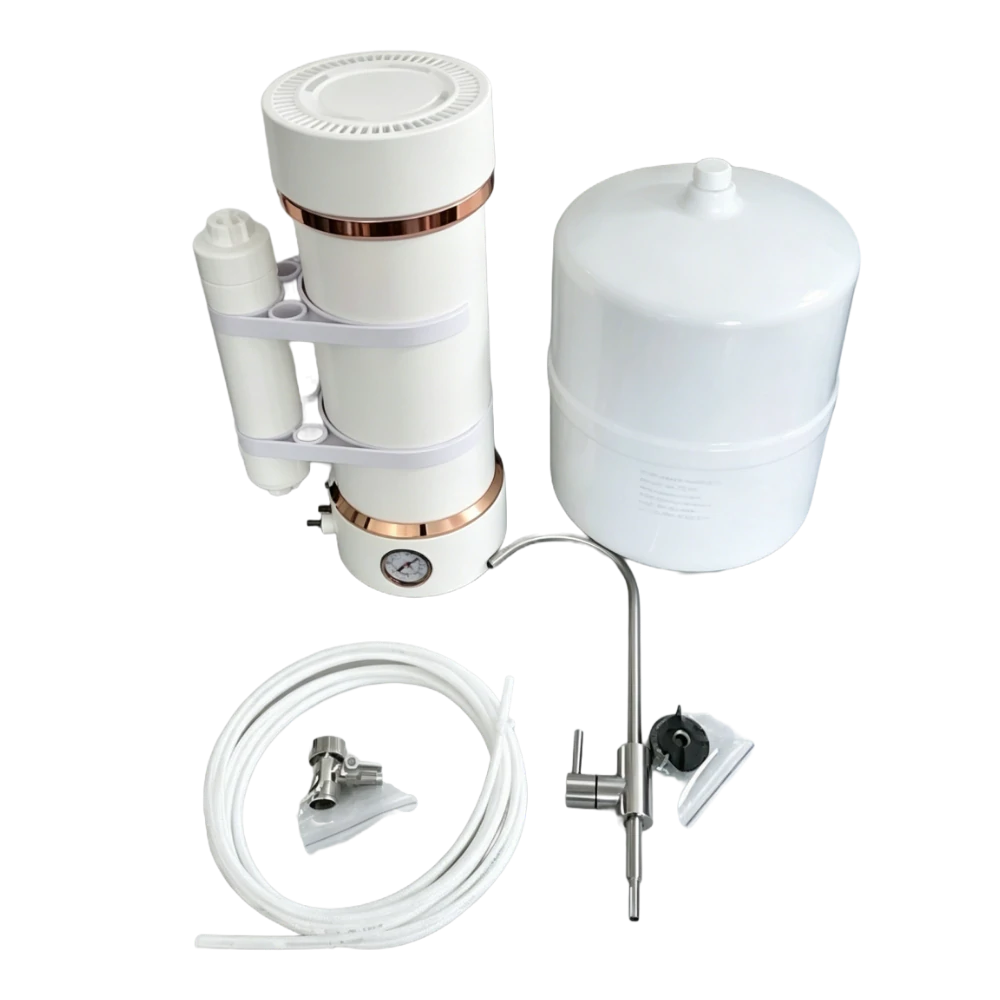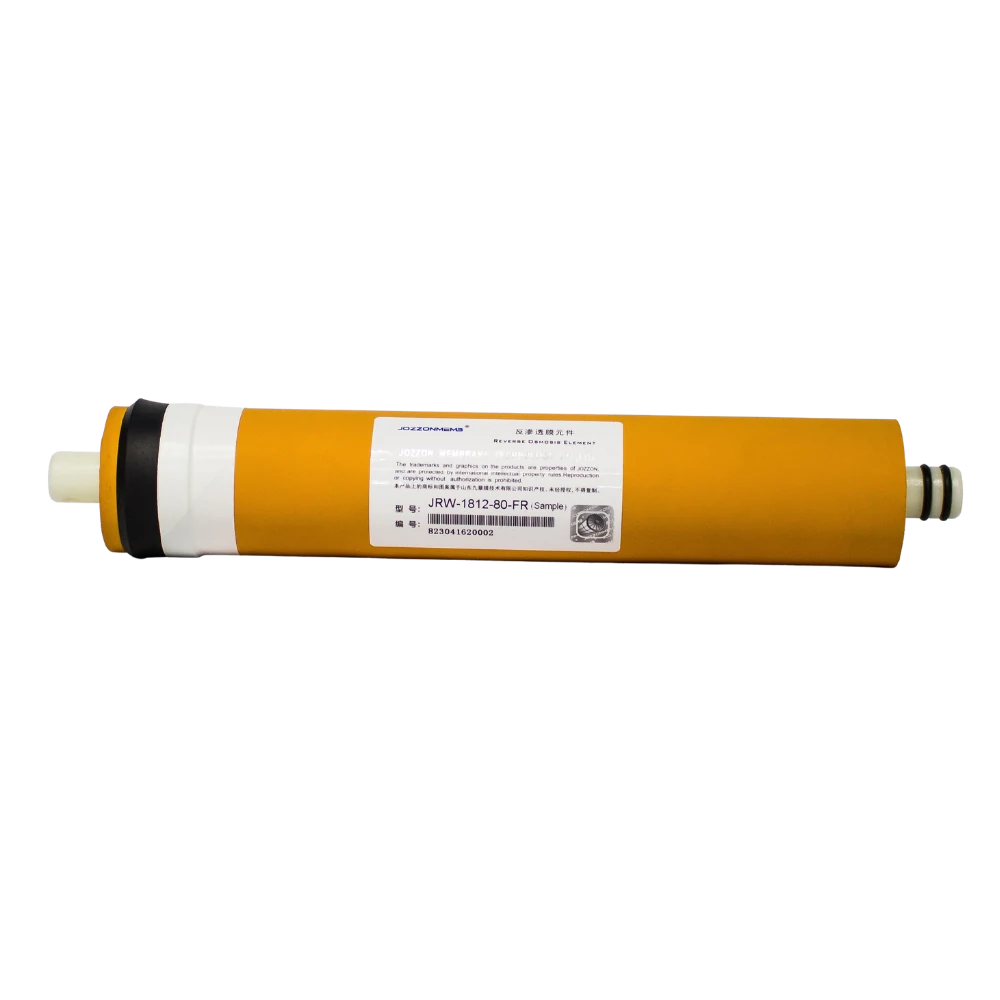
Ultrafiltration (UF) and reverse osmosis (RO) are pressure-driven membrane technologies designed for different water treatment objectives. UF primarily removes suspended solids, colloids, and many microorganisms, while RO reduces dissolved salts and a broad range of dissolved contaminants.
Understanding the differences between UF and RO membranes helps engineers, plant operators, and procurement teams select the appropriate technology based on feed water quality, required permeate quality, and operating costs. In industrial water treatment, the two technologies can also work together, with UF reducing particulate loading before RO.
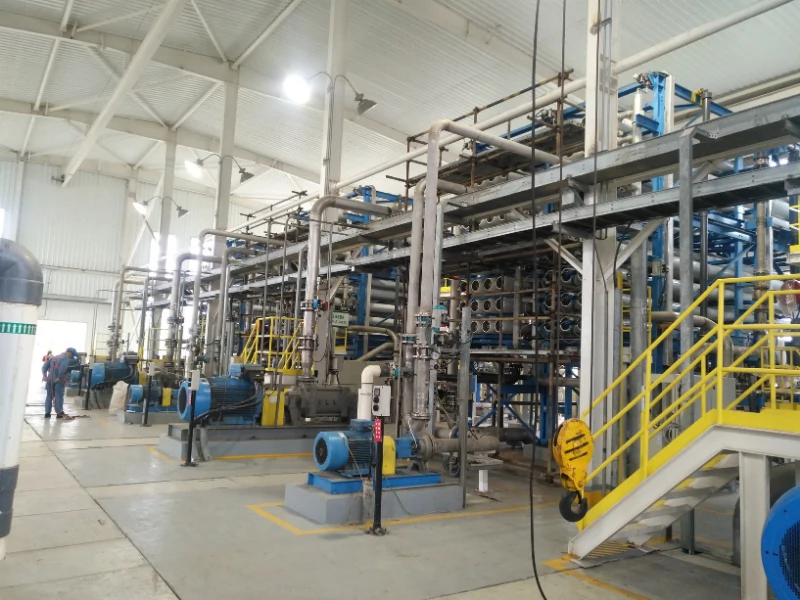
Understanding the Fundamentals: What Are UF and RO Membranes?
What Is an Ultrafiltration (UF) Membrane?
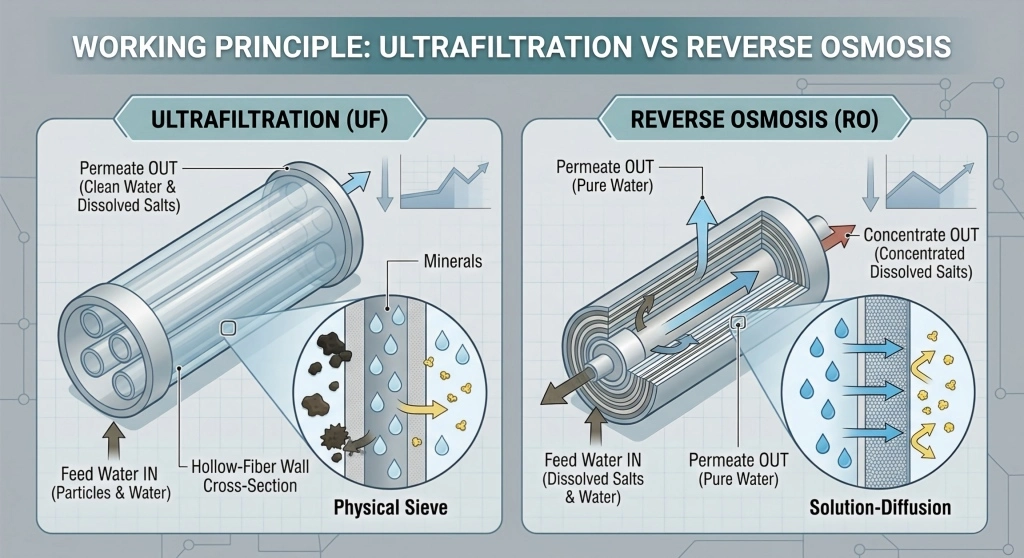
An ultrafiltration membrane is a porous barrier that separates particles and macromolecules primarily through size exclusion. Under applied pressure, water and sufficiently small substances pass through the membrane while suspended solids, colloids, and larger materials are retained.
UF membranes are widely used for surface water clarification, industrial water treatment, wastewater reuse, and RO pretreatment. Depending on membrane specifications and system integrity, they can also retain many bacteria and protozoan cysts. However, most dissolved salts pass through UF membranes, so UF is not designed for desalination.
What Is a Reverse Osmosis (RO) Membrane?
A reverse osmosis membrane uses a dense selective layer to separate water from dissolved salts and other rejected substances. Applied pressure drives water through the membrane against osmotic pressure, producing permeate with reduced dissolved-solids content and a concentrate stream containing much of the rejected material.
RO is commonly used for brackish water desalination, industrial process water production, and applications requiring low-TDS water. Its performance depends on membrane characteristics, feed water composition, temperature, operating pressure, and system recovery. Appropriate pretreatment and operating controls are essential to limit fouling and scaling.
What Is the Difference Between UF and RO Membranes?
How Does an Ultrafiltration (UF) Membrane Work?
UF separates contaminants according to their effective size relative to the membrane’s pore structure. As feed water passes through the system, water permeates the membrane while retained particles remain in the concentrate or accumulate on the membrane surface. Depending on the configuration, UF systems may use dead-end or crossflow filtration, backwashing, and periodic chemical cleaning to control fouling.
Because UF operates at relatively low pressure and effectively removes particulate matter, it is suitable for clarification and pretreatment. However, its porous structure does not provide the dissolved-salt rejection required for desalination.
How Does a Reverse Osmosis (RO) Membrane Work?
RO uses a semipermeable selective layer to reject most dissolved salts while allowing water to pass under sufficient pressure. The process produces a low-solids permeate stream and a concentrate stream containing much of the rejected material.
Unlike UF, RO targets dissolved substances that particle filtration cannot effectively remove. System design must therefore account for osmotic pressure, salt rejection, scaling potential, and concentrate management.
UF vs RO Membrane: Key Differences at a Glance
|
Comparison Factor |
UF Membrane |
RO Membrane |
|
Separation mechanism |
Size exclusion through a porous membrane |
Separation through a dense selective layer |
|
Main removal targets |
Suspended solids, colloids, and many microorganisms |
Dissolved salts and a broad range of dissolved contaminants |
|
Dissolved salt removal |
Generally limited |
High, depending on membrane and operating conditions |
|
Typical operating pressure |
Generally lower |
Generally higher |
|
Energy requirements |
Usually lower for the membrane separation stage |
Usually higher due to pressure requirements |
|
Common applications |
Clarification, wastewater reuse, RO pretreatment |
Desalination, TDS reduction, industrial process water |
|
Maintenance considerations |
Backwashing and chemical cleaning, as required |
Scaling control, chemical cleaning, and performance monitoring |
Actual pressure, energy consumption, and removal performance vary with feed water quality, membrane configuration, and system design.
UF vs RO: What Can Each Membrane Remove?
Contaminants Removed by UF
UF primarily removes suspended particles, turbidity-causing materials, colloids, and certain larger organic molecules. It can also retain many bacteria and protozoan cysts when membrane specifications and system integrity support the required performance.
Most dissolved salts and smaller dissolved substances pass through UF membranes. Consequently, UF can improve water clarity without significantly reducing total dissolved solids (TDS).
Contaminants Removed by RO
RO is designed to reject most dissolved salts and can reduce many inorganic ions and selected organic contaminants. This makes it suitable for desalination and applications requiring substantial TDS reduction.
RO does not remove every contaminant under all conditions. Actual rejection depends on membrane selectivity, contaminant characteristics, feed water composition, and operating conditions; performance should therefore be evaluated against the required permeate specifications.
Why Does Water Quality Determine the Choice?
The key difference between UF and RO is the type of contamination that needs to be controlled. UF is generally appropriate when suspended solids and colloids are the main concern, whereas RO is preferred when dissolved salts must be significantly reduced.
Feed water analysis—including turbidity, suspended solids, TDS, hardness, and organic matter—helps determine whether a single membrane process or a combined treatment system is necessary.
UF vs RO: Operating Pressure, Energy, and Maintenance
Operating Pressure and Energy Consumption
UF generally operates at lower pressure because it does not need to overcome the osmotic pressure associated with dissolved salts. RO requires higher pressure, particularly when treating more saline feed water or targeting lower permeate TDS.
Although UF typically requires less energy for the membrane separation stage, total system consumption also depends on pumping, backwashing, pretreatment, and other auxiliary processes. Energy requirements should therefore be assessed in relation to the treatment objective and complete system design.
Fouling, Scaling, and Cleaning
UF membranes can experience particulate, colloidal, and organic fouling, which may require backwashing and periodic chemical cleaning. RO membranes face these risks as well as scaling caused by sparingly soluble salts, making feed water management and scaling control particularly important.
Both technologies require appropriate pretreatment, performance monitoring, and cleaning procedures to maintain stable operation and extend membrane service life.
Total Treatment Cost
Lifecycle cost includes energy, pretreatment equipment, cleaning chemicals, membrane replacement, maintenance labor, water recovery, and concentrate or wastewater management.
UF may be more economical for solids removal, but it cannot replace RO when desalination is required. Conversely, using RO when only particle removal is necessary may introduce unnecessary pressure and treatment costs. The most suitable solution is the one that meets the required water quality reliably at an appropriate total cost.
UF and RO Water Treatment: Typical Applications
When Is UF the Better Choice?
UF is suitable when the primary objective is to reduce suspended solids, turbidity, and colloidal loading. Typical applications include:
- Surface water clarification and filtration.
- Industrial water treatment requiring particle removal.
- Wastewater treatment and reuse where dissolved-salt reduction is not the main objective.
- Food, beverage, and dairy processing applications involving clarification or macromolecule separation.
- Pretreatment for RO and other downstream processes.
In these applications, UF improves water clarity and can reduce the particulate load entering subsequent treatment stages.
When Is RO the Better Choice?
RO is generally preferred when significant dissolved-salt reduction or desalination is required. Common applications include:
- Brackish water and seawater desalination.
- Industrial process water production.
- Feed water treatment for power generation and electronics manufacturing.
- Pharmaceutical and specialized chemical processing requiring controlled water quality.
- Systems requiring low-TDS or low-conductivity water, sometimes followed by additional polishing.
The final treatment configuration depends on the water quality specification and the requirements of the application.
UF or RO: Which Is Better?
Neither technology is universally better. UF is generally more suitable for suspended-solids and colloid removal, while RO is the preferred option when dissolved salts must be reduced. The decision should reflect feed water composition, target permeate quality, operating requirements, and lifecycle cost.
Where both particle removal and desalination are required, combining UF and RO may provide a more effective solution than relying on either technology alone.
Synergy in Water Treatment: Using Ultrafiltration as RO Pretreatment
Ultrafiltration as RO pretreatment can reduce turbidity, suspended solids, and colloidal loading before water enters an RO system. By limiting particulate loading on the downstream membrane, UF can help reduce the risk of particulate fouling and support more stable RO operation.
A typical treatment sequence is:
Feed Water → UF System → Additional Pretreatment as Required → RO System → Treated Water
UF does not eliminate every pretreatment requirement. Depending on feed water chemistry, additional measures may still be needed to control scaling potential, dissolved organic matter, or other contaminants that UF cannot adequately remove.
In this integrated process, UF handles much of the suspended and colloidal load, while RO reduces dissolved salts and other rejected substances. This combination can be valuable in industrial water treatment and wastewater reuse projects where both stable operation and consistent permeate quality are important.
How to Choose Between a UF Membrane and an RO Membrane
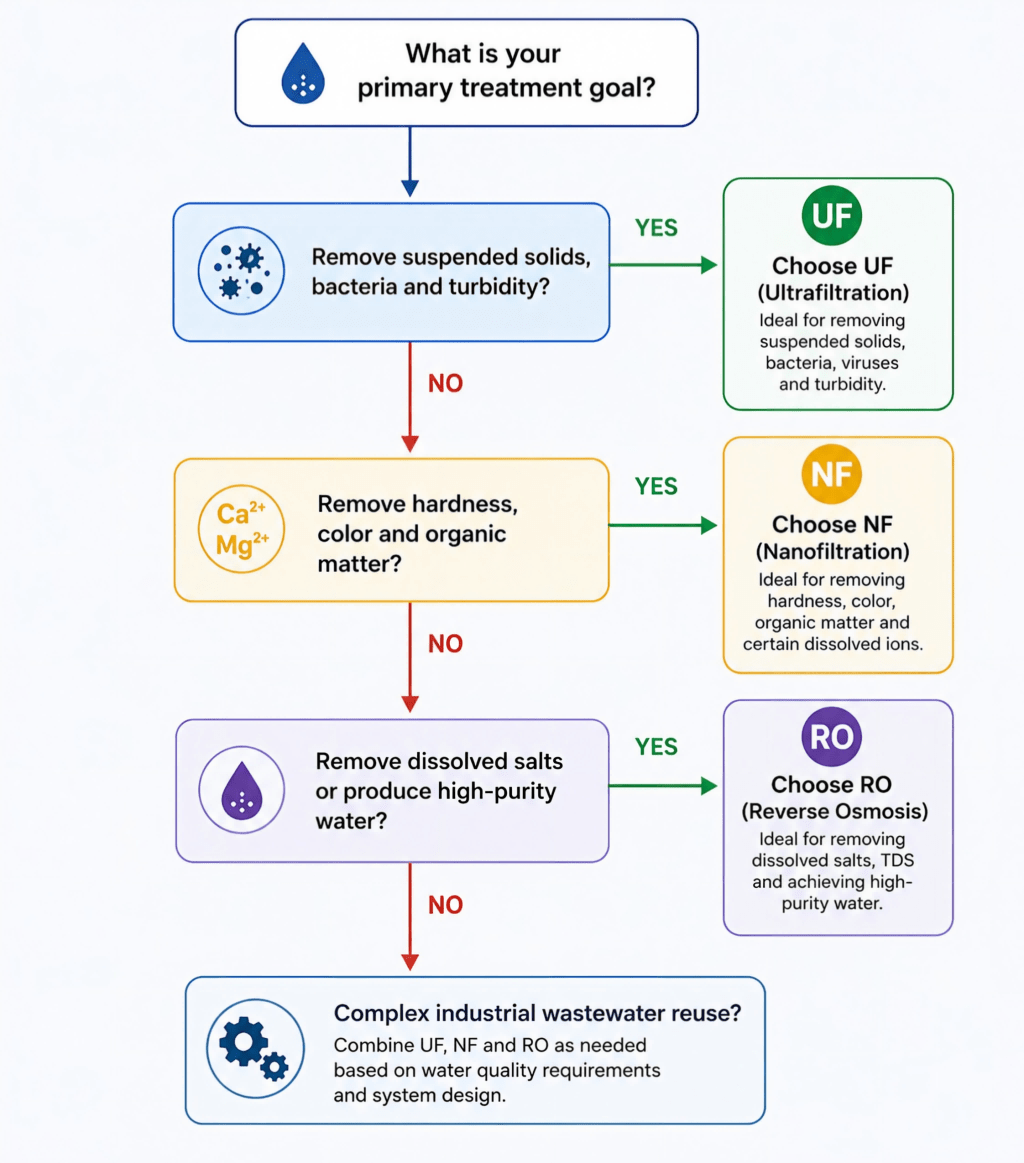
Selecting the right membrane requires matching the treatment process to feed water characteristics and final water quality requirements.
- Analyze feed water quality. Evaluate turbidity, suspended solids, TDS, hardness, organic matter, and other relevant parameters to identify the main treatment challenges.
- Define the treatment objective. Determine whether the priority is clarification, particle removal, wastewater reuse, desalination, or low-TDS water production.
- Confirm permeate requirements. Establish the water quality limits required by the final application or downstream process.
- Evaluate operating and maintenance costs. Consider pressure, energy consumption, recovery, cleaning frequency, membrane replacement, and concentrate management.
- Select the complete treatment process. Determine whether UF alone is sufficient, RO is required, or a combined UF–RO system offers the best balance of performance and cost. For complex feed water, pilot testing or engineering assessment may help validate the design.
Conclusion
The main distinction between UF and RO membranes lies in their separation mechanisms and treatment capabilities. UF primarily removes suspended solids, colloids, and many microorganisms, whereas RO reduces dissolved salts and a broad range of dissolved contaminants. UF is therefore commonly used for clarification and pretreatment, while RO is preferred for desalination and low-TDS water production.
For many industrial applications, these technologies complement rather than replace each other. Matching membrane selection to feed water quality, permeate requirements, and operating conditions helps establish a reliable and cost-effective treatment process.
JOZZON provides membrane solutions for industrial water treatment applications. Explore our membrane product range or contact our team to discuss your project requirements and identify a suitable membrane approach.