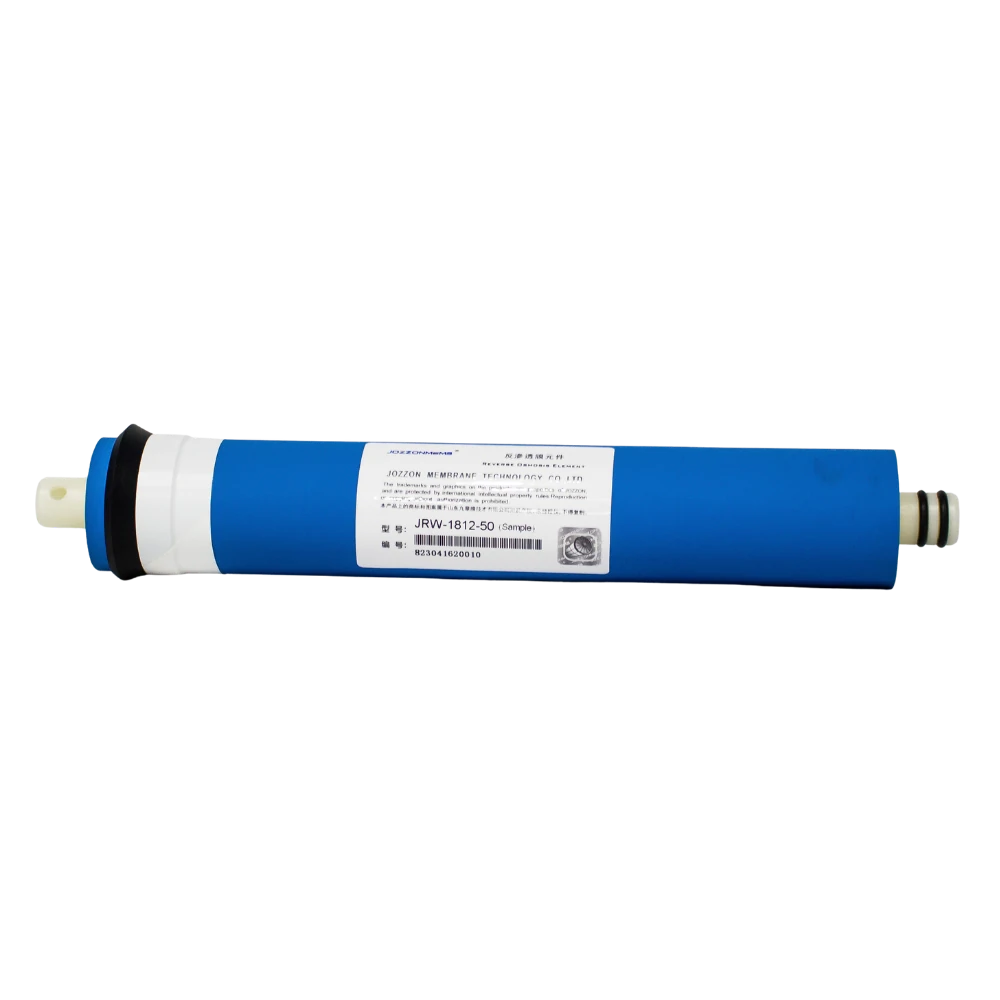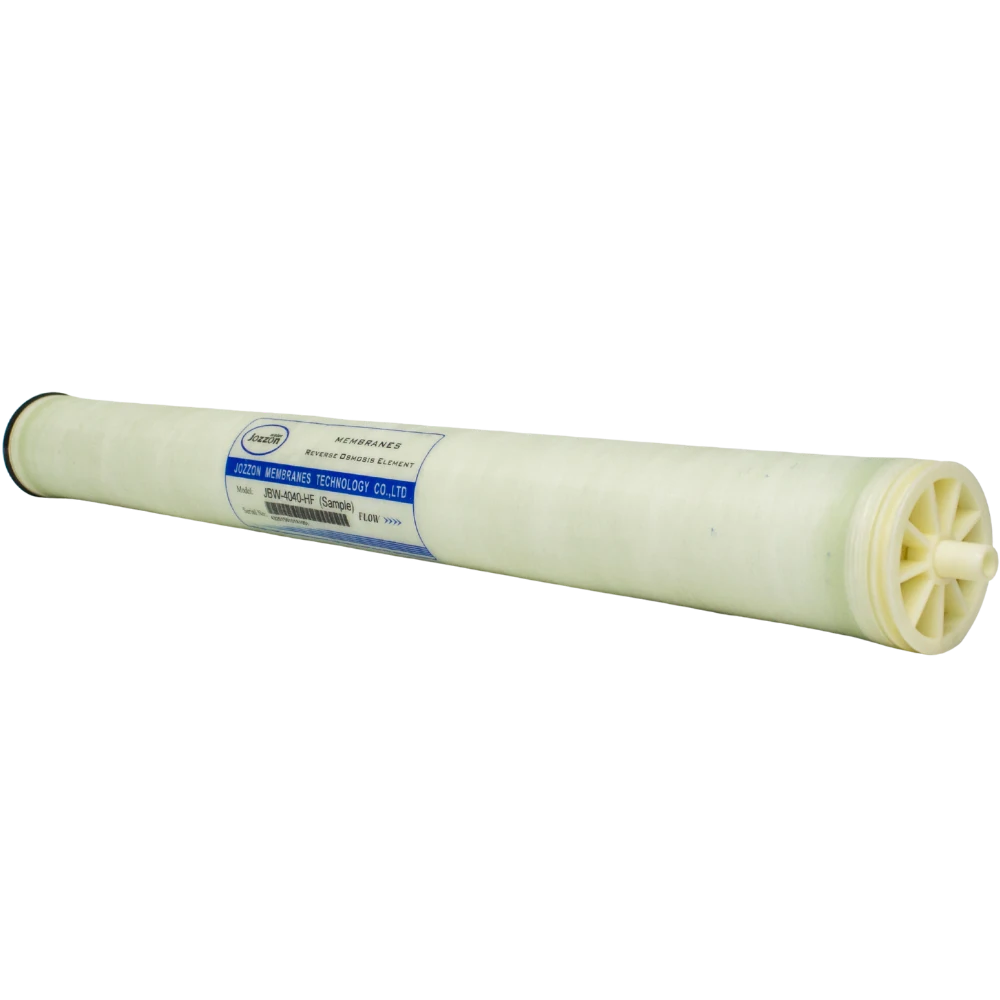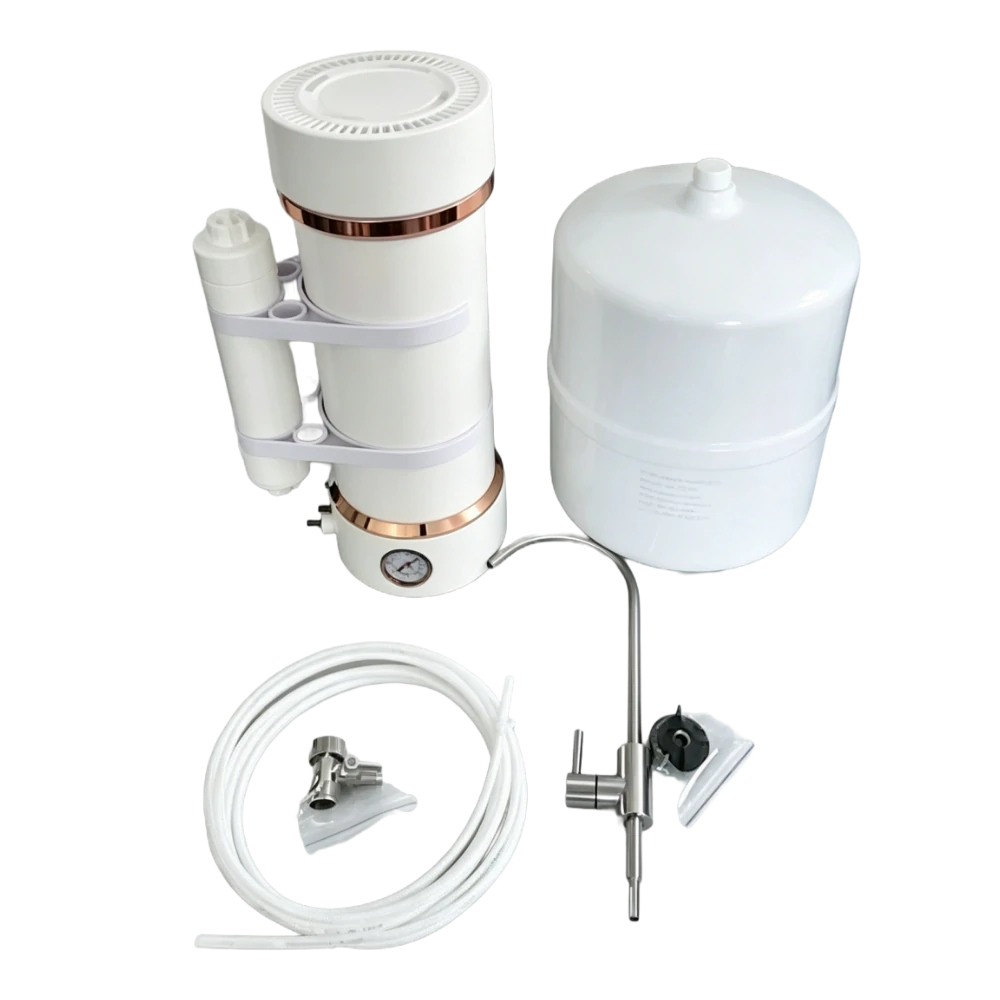
Water treatment technologies have advanced rapidly over the past few decades, with membrane filtration becoming one of the most efficient and reliable methods for producing clean water. Among the available technologies, reverse osmosis (RO), nanofiltration (NF), and ultrafiltration (UF) are the three most widely used membrane processes for municipal, commercial, and industrial water treatment. Although they all rely on pressure-driven membrane separation, each technology is designed to remove different contaminants and achieve different treatment objectives.
Choosing the right membrane directly affects water quality, system recovery, operating pressure, energy consumption, maintenance frequency, and overall lifecycle cost. Selecting a membrane with excessive purification capability may increase operating expenses unnecessarily, while choosing one with insufficient separation performance can result in water that fails to meet process requirements.
This guide compares RO vs NF vs UF membrane technologies, explaining how each membrane works, their strengths and limitations, common industrial applications, and the key factors to consider when selecting the most suitable membrane for your water treatment system.
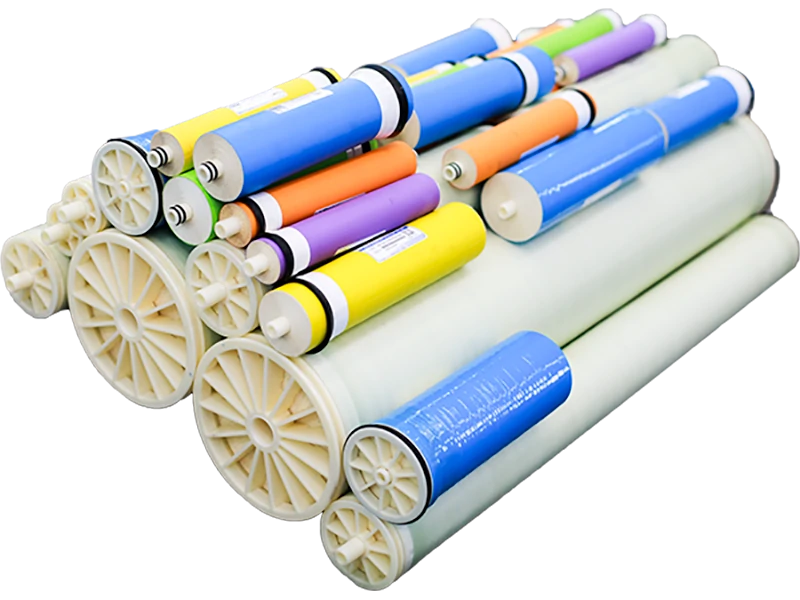
The Membrane Filtration Spectrum (At-a-Glance Comparison)
RO, NF, and UF belong to the same family of pressure-driven membrane technologies but differ significantly in separation capability. As filtration precision increases, operating pressure, salt rejection, and energy consumption also increase.
|
Membrane Type |
Typical Pore Size |
Operating Pressure |
Separation Mechanism |
Primary Target |
Typical Applications |
Relative Operating Cost |
|
Ultrafiltration (UF) |
0.01–0.1 μm |
1–5 bar |
Size exclusion |
Suspended solids, bacteria, viruses |
Pretreatment, municipal water, wastewater |
Low |
|
Nanofiltration (NF) |
~1 nm |
5–20 bar |
Size exclusion + charge effect |
Hardness, color, organic matter |
Water softening, industrial process water |
Medium |
|
Reverse Osmosis (RO) |
Dense non-porous membrane |
10–80 bar |
Solution-diffusion |
Dissolved salts, heavy metals, TDS |
Desalination, ultrapure water |
High |
Rather than competing technologies, these membranes often complement one another within a complete treatment train. For example, UF is frequently installed upstream of an RO system to remove suspended solids and reduce membrane fouling, while NF can serve as an intermediate process where partial desalination or hardness removal is required.
What Are RO, NF, and UF Membranes?
What Is a Reverse Osmosis (RO) Membrane?
A reverse osmosis membrane provides the highest level of separation among pressure-driven membrane technologies. It uses a dense thin-film composite membrane that allows water molecules to pass while rejecting nearly all dissolved salts, heavy metals, microorganisms, and many organic contaminants.
RO operates by applying pressure greater than the natural osmotic pressure of the feed water. Water molecules diffuse through the membrane, while dissolved impurities remain on the feed side and are discharged as concentrate.
Advantages
- Excellent removal of dissolved salts and TDS
- High rejection of heavy metals and microorganisms
- Produces high-purity water
- Suitable for demanding industrial applications
Limitations
- Higher operating pressure and energy consumption
- Requires effective pretreatment
- Generates concentrate that requires proper disposal
Typical Applications
- Seawater desalination
- Brackish water treatment
- Boiler feed water
- Pharmaceutical manufacturing
- Electronics and semiconductor production
- Industrial wastewater reuse
What Is a Nanofiltration (NF) Membrane?
Nanofiltration occupies the middle position between RO and UF. It selectively removes multivalent ions, hardness, color, and large organic molecules while allowing part of the monovalent salts to pass through.
Unlike RO, which aims for maximum desalination, NF is designed for selective separation. This makes it ideal for applications where complete salt removal is unnecessary but water softening or organic removal is required.
Advantages
- Lower energy consumption than RO
- Excellent hardness removal
- Effective removal of natural organic matter and color
- Higher water recovery in many applications
Limitations
- Does not completely remove dissolved salts
- Lower product water purity than RO
- Not suitable for seawater desalination
Typical Applications
- Water softening
- Surface water treatment
- Food and beverage processing
- Textile wastewater treatment
- Dye and color removal
- Industrial process water
What Is an Ultrafiltration (UF) Membrane?
Ultrafiltration is a low-pressure membrane technology primarily used to remove suspended solids, colloids, bacteria, viruses, and other particulate contaminants. Unlike RO and NF, UF does not significantly remove dissolved minerals or salts.
Because of its relatively large pore size and low operating pressure, UF is widely used as a pretreatment process that protects downstream RO or NF membranes from fouling.
Advantages
Low operating pressure
High water recovery
Excellent removal of suspended particles
Effective microbial barrier
Low operating cost
Limitations
Cannot remove dissolved salts or hardness
Limited removal of dissolved organic compounds
Often requires downstream treatment for high-purity water production
Typical Applications
Municipal drinking water
Surface water treatment
Pretreatment for RO systems
Food processing
Pharmaceutical pretreatment
Wastewater reclamation
Difference Between RO and UF
One of the most frequently searched topics is the difference between RO and UF. Although both technologies use pressure-driven membranes, they target different contaminants and serve different treatment goals.
|
Feature |
UF |
RO |
|
Operating Pressure |
Low |
High |
|
Removes Suspended Solids |
✔ |
✔ |
|
Removes Bacteria & Viruses |
✔ |
✔ |
|
Removes Dissolved Salts |
✖ |
✔ |
|
Removes Hardness |
✖ |
✔ |
|
Energy Consumption |
Low |
High |
|
Typical Use |
Pretreatment |
Final purification |
UF is ideal for removing suspended particles and microorganisms while preserving naturally dissolved minerals. RO, on the other hand, is designed to remove dissolved salts and produce high-quality purified water. In many industrial systems, UF and RO work together rather than replacing one another.
RO vs Nanofiltration
When comparing RO vs nanofiltration, the biggest difference lies in their separation objectives.
|
Feature |
NF |
RO |
|
Salt Removal |
Partial |
Nearly complete |
|
Hardness Removal |
Excellent |
Excellent |
|
Operating Pressure |
Medium |
High |
|
Energy Consumption |
Moderate |
Higher |
|
Typical Applications |
Water softening |
Desalination |
Nanofiltration is often selected when hardness removal, color reduction, or organic removal is the primary objective, while reverse osmosis remains the preferred technology for desalination and high-purity water production.
Ultrafiltration vs Nanofiltration
The comparison of Ultrafiltration vs nanofiltration focuses on the removal of dissolved contaminants.
|
Feature |
UF |
NF |
|
Removes Suspended Solids |
✔ |
✔ |
|
Removes Bacteria |
✔ |
✔ |
|
Removes Hardness |
✖ |
✔ |
|
Removes Dissolved Salts |
✖ |
Partial |
|
Typical Applications |
Pretreatment |
Water softening |
UF primarily separates particles based on size, whereas NF combines size exclusion with electrostatic interactions to selectively remove dissolved compounds. Consequently, NF provides higher water quality but requires higher operating pressure.
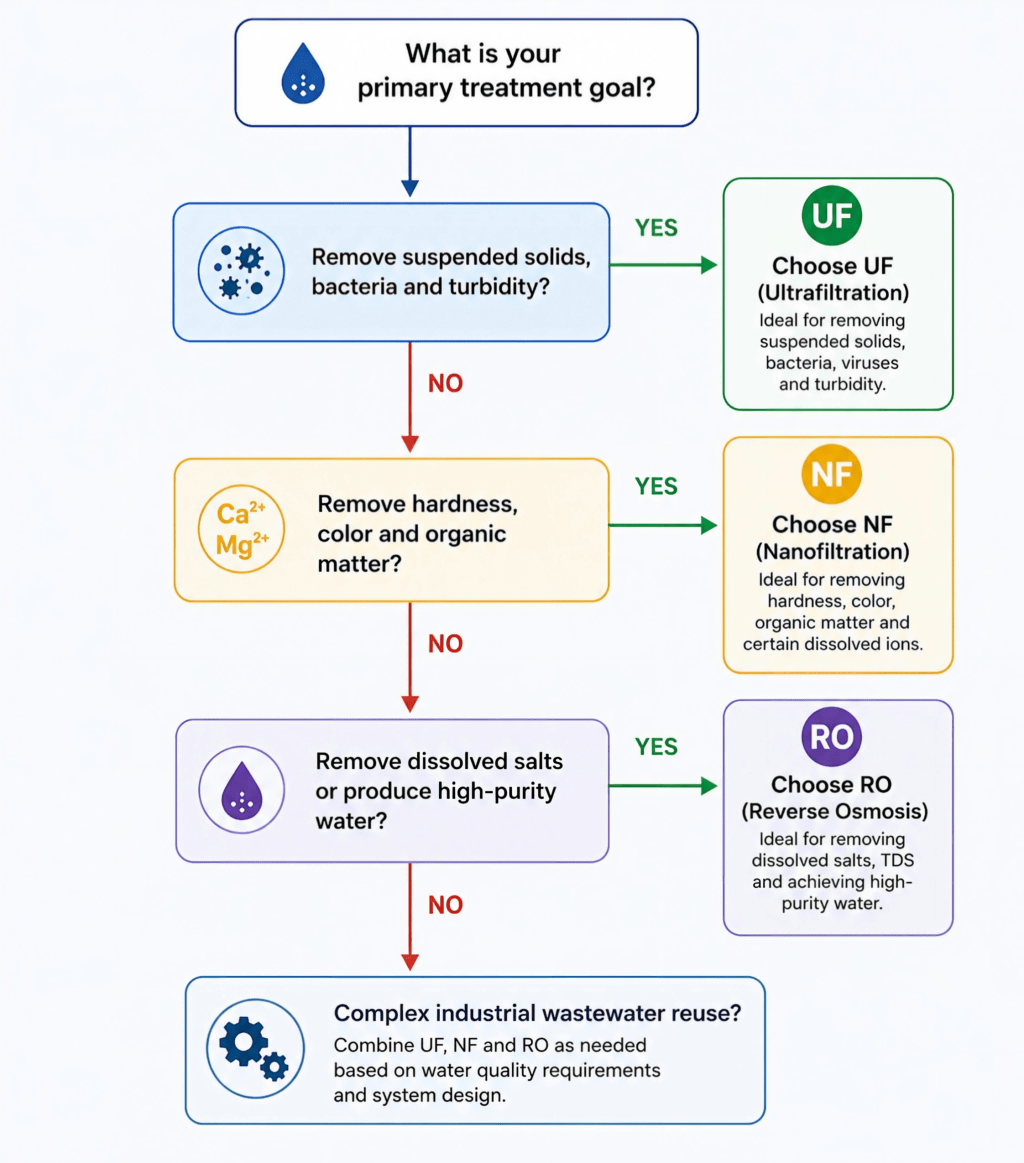
Which Membrane Should I Choose?
Many engineers and plant operators ask, “Which membrane should I choose?” The answer depends on your feed water quality, required product water specifications, operating budget, and system design.
| Treatment Objective | Recommended Membrane |
|---|---|
| Remove suspended solids and microorganisms | UF |
| Remove hardness and organic matter | NF |
| Remove dissolved salts and TDS | RO |
| Wastewater reuse | UF + RO |
| Seawater desalination | UF + RO |
| High-purity industrial water | RO |
When selecting a membrane, evaluate the following factors:
- Feed water quality and TDS level
- Required product water quality
- Target contaminants
- Operating pressure
- Water recovery
- Energy consumption
- Membrane fouling potential
- Cleaning frequency
- Total lifecycle cost
Expert Tips for Choosing the Right Membrane Technology
A successful membrane system begins with accurate feed water analysis. Understanding parameters such as hardness, turbidity, SDI, pH, organic content, and dissolved solids allows engineers to select the most appropriate membrane configuration.
Avoid choosing a membrane solely based on the highest rejection rate. Excessive purification may increase energy costs without providing additional value. Instead, match membrane performance to the actual process requirements while considering long-term operating efficiency, maintenance requirements, and future expansion.
Working with an experienced membrane manufacturer can also simplify the selection process. Professional technical support, application-specific recommendations, and system optimization help maximize membrane life and improve overall system reliability.
Membrane Selection Flowchart
Conclusion
Understanding the differences between RO vs NF vs UF membrane technologies is essential for selecting the right solution for any water treatment project. While all three rely on pressure-driven membrane separation, they differ significantly in contaminant removal capability, operating pressure, energy consumption, and application scope.
Ultrafiltration is best suited for removing suspended solids and microorganisms while serving as an effective pretreatment technology. Nanofiltration offers selective removal of hardness, color, and organic matter with lower energy consumption than reverse osmosis. Reverse osmosis provides the highest level of purification by removing dissolved salts and producing high-quality water for desalination, industrial processing, and ultrapure water applications.
There is no single membrane that is ideal for every application. The optimal solution depends on feed water characteristics, treatment objectives, and long-term operating requirements. As a professional membrane solution provider, JOZZON offers high-performance reverse osmosis, nanofiltration, and ultrafiltration membrane products, along with expert technical support to help customers design efficient, reliable, and cost-effective water treatment systems.