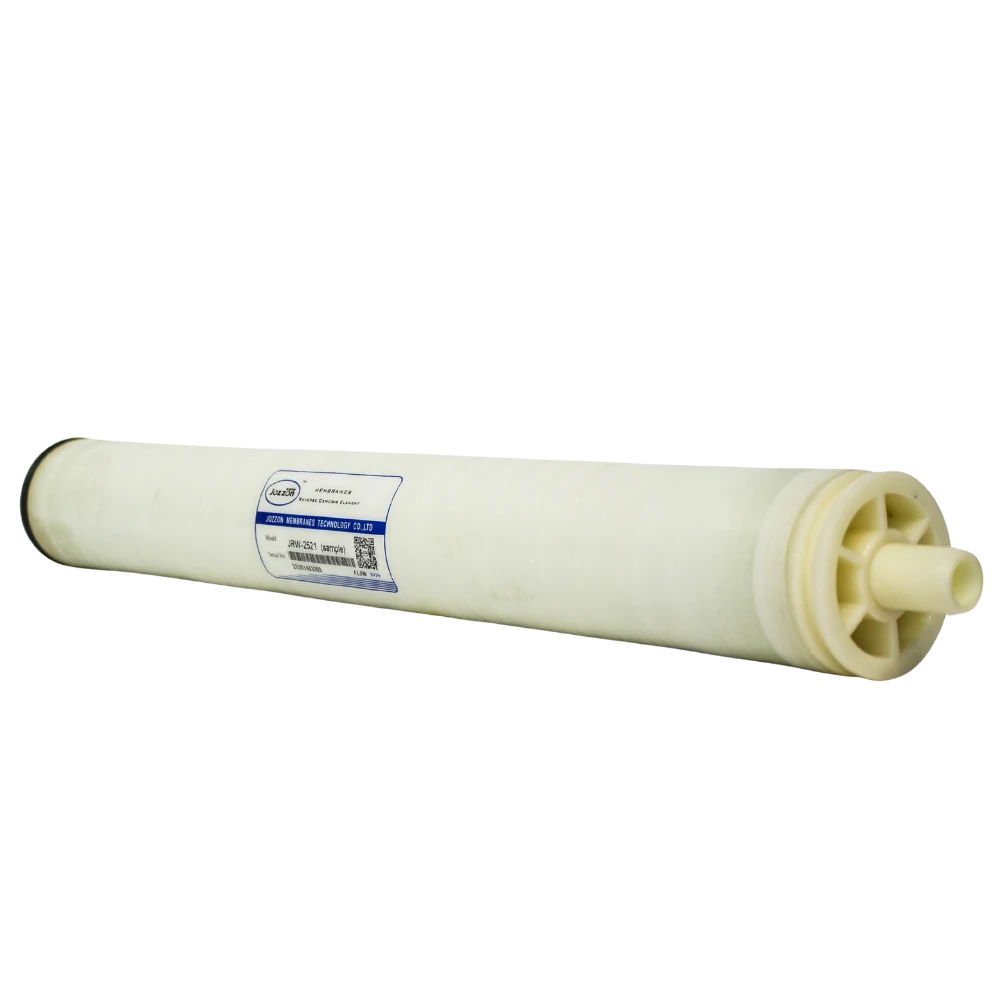
Reverse osmosis technology is widely used across industries—from industrial pure water production and municipal supply to seawater desalination and wastewater reuse. But behind the control panels and pressure vessels lies a set of fundamental principles and water quality parameters that determine success or failure.
This article breaks down the essential concepts of reverse osmosis in clear, practical terms. Whether you’re selecting equipment, managing operations, or simply looking to understand the technology better, this guide will give you a solid foundation.
1. How Reverse Osmosis Works: A Molecular-Level Filter
At its core, reverse osmosis operates on a simple principle: when pressure greater than the natural osmotic pressure is applied to a solution, water molecules are forced through a semipermeable membrane, while dissolved salts, organics, and colloids are rejected.
Think of it as an extremely fine sieve—pores are measured in nanometers, allowing only water molecules to pass while blocking most ions and organic compounds.
2. Common Units You’ll Encounter
Understanding these units is essential for interpreting system performance:
- ppm and mg/L: Parts per million is equivalent to milligrams per liter. In practice, 1 ppm = 1 mg/L. For lower concentrations, 1000 ppb = 1 ppm.
- TDS (Total Dissolved Solids): Measures the total amount of dissolved substances in water, expressed in mg/L. It’s the most frequently used indicator of water purity.
- GPD (Gallons Per Day): The flow rate of a membrane element. 1 gallon = 3.785 liters.
- GFD (Gallons Per Square Foot Per Day): Membrane flux expressed per unit area. Conversion: 1 L/(m²·h) ≈ 0.589 GFD.
3. Critical Water Quality Parameters
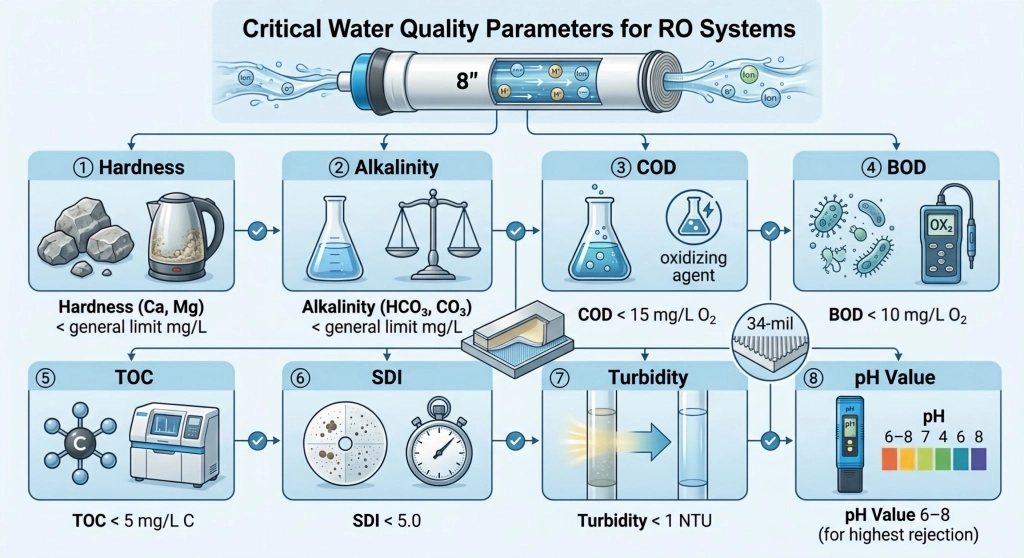
RO systems have specific feed water requirements. Understanding these parameters helps you design effective pretreatment and extend membrane life.
(1) Hardness
This measures calcium and magnesium content, typically calculated as CaCO₃. General classification:
- 0–40 mg/L: Very soft
- 40–80 mg/L: Soft
- 80–160 mg/L: Moderately hard
- 160–300 mg/L: Hard
High hardness increases scaling risk, often requiring antiscalants or softening pretreatment.
(2) Alkalinity
Alkalinity reflects the water’s capacity to neutralize acids, primarily from hydroxides, carbonates, and bicarbonates. High alkalinity can contribute to scaling and pH instability.
(3) COD (Chemical Oxygen Demand)
COD measures the amount of oxidizable substances—mostly organics—in water. For RO systems, the recommended limit is COD (O₂ basis) < 15 mg/L. Higher levels can lead to organic fouling on membrane surfaces.
(4) BOD (Biochemical Oxygen Demand)
BOD indicates the oxygen consumed by microorganisms when decomposing biodegradable organics. Typical RO requirement: BOD (O₂ basis) < 10 mg/L.
(5) TOC (Total Organic Carbon)
TOC expresses the total organic content as carbon concentration. The general RO guideline is TOC (C basis) < 5 mg/L.
(6) SDI (Silt Density Index)
SDI is a key indicator of suspended particles and colloids that can clog membranes. RO systems generally require SDI < 5.0—the lower, the better.
(7) Turbidity
Turbidity measures light scattering caused by suspended solids. For RO feed water, it’s typically kept below 1 NTU to prevent surface fouling.
(8) pH Value
pH affects both carbonate chemistry and membrane rejection performance. Most RO membranes achieve their highest salt rejection in the pH range of 6–8. Outside this range, rejection rates drop noticeably.
4. Operational Risks You Shouldn’t Ignore
Even with proper feed water quality, operational issues can arise during startup, shutdown, or abnormal conditions.
(1) Back Pressure
This occurs when the permeate-side pressure exceeds the feed-side pressure. It rarely happens during normal operation but can occur during shutdown or improper valve positioning, potentially causing permanent membrane damage.
(2) Differential Pressure (ΔP)
Differential pressure is the pressure drop between the feed and concentrate sides. Under normal conditions, total system ΔP stays around 0.1 MPa, with each stage contributing approximately 0.05 MPa. A rising ΔP indicates foulant accumulation on membrane surfaces and signals the need for cleaning.
(3) Water Hammer
When air remains trapped in the system, sudden pressurization can create a shock wave—water hammer—that may shift or even rupture membrane elements. Always perform low-pressure flushing to vent air before system startup.
5. Recovery Rate and Membrane Selection
Recovery rate is the percentage of feed water converted to permeate. Higher recovery reduces concentrate discharge but increases scaling and fouling risks—optimal values depend on feed water chemistry.
In membrane element construction, the feed spacer (also called brine spacer) thickness affects pressure drop. Common thicknesses are 28 mil, 31 mil, and 34 mil. A 34-mil spacer offers wider channels, lowering pressure loss and improving cleaning efficiency—particularly advantageous for challenging feed waters.
Two additional membrane properties matter:
- Hydrophilicity (measured by contact angle): Smaller angles mean better water wettability and higher permeability.
- Surface charge neutrality: Membranes with near-neutral charge reduce electrostatic attraction of charged solutes, significantly delaying fouling—a critical feature in high-performance anti-fouling products.
6. Beyond the Basics: What Really Separates Good from Great
The concepts covered above are the essentials—but in real-world engineering, success depends on how precisely you control every parameter, and how well you integrate membrane chemistry, fluid dynamics, and system design.
Jozzon Membrane Technology Co., Ltd. builds on this fundamental knowledge to deliver measurable performance advantages. Our proprietary charge-neutral surface modification reduces fouling rates. Our end-cap vortex technology, developed through computational fluid dynamics, enhances flow velocity and reduces pressure drop. Our 34-mil wide-channel elements improve cleanability in demanding applications.
With an annual production capacity exceeding 3 million m², an R&D team where over 60% hold bachelor’s degrees or higher, and proven track records in large-scale industrial projects—including a 6,484-element deployment in a major coal-mine water treatment facility—Jozzon turns every basic concept into reliable, field-verified results.
Clean water starts with getting the fundamentals right—and we’ve mastered them.