The stable operation of a water treatment system depends heavily on understanding the quality of its feed water. Before selecting an RO membrane or designing a pretreatment system, operators need to evaluate key water quality parameters in water treatment, including hardness, alkalinity, COD, BOD, SDI, turbidity, and pH.
These parameters indicate the potential for scaling, fouling, clogging, and other operating challenges. Understanding RO feed water quality helps determine appropriate pretreatment requirements, membrane selection, and operating conditions, ultimately supporting more stable RO system performance and longer membrane service life.
What Are Water Quality Parameters?
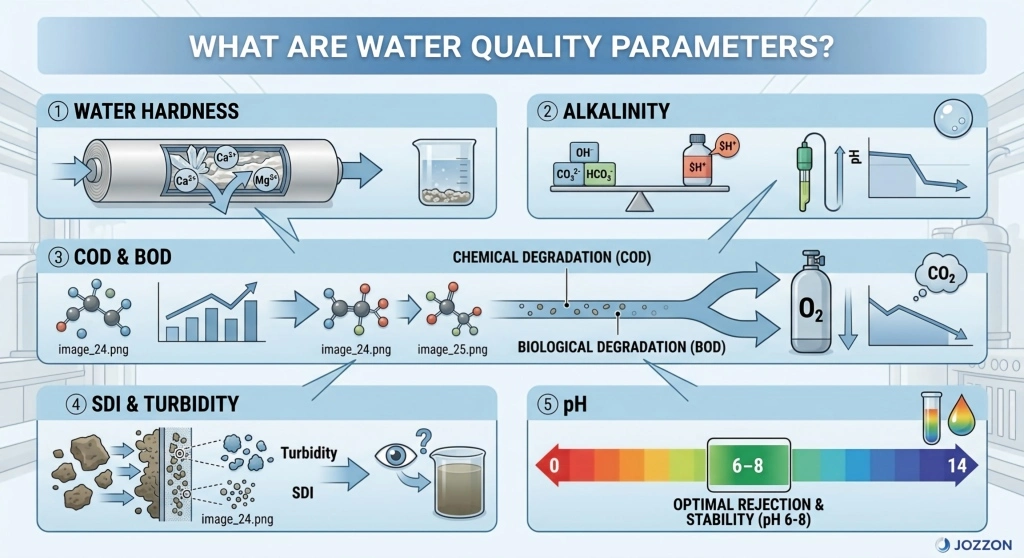
Water quality parameters are measurable physical, chemical, and biological characteristics used to evaluate the condition of water and determine whether it is suitable for a specific treatment process.
For RO systems, these parameters are particularly important because the membrane is sensitive to suspended solids, organic matter, dissolved minerals, and changes in water chemistry. Evaluating the RO feed water parameters before membrane selection helps identify potential scaling and fouling risks and provides a basis for designing appropriate pretreatment.
The most relevant parameters vary depending on the water source and treatment objective, but common RO feed water parameters include:
- Water hardness
- Alkalinity
- COD and BOD
- SDI and turbidity
- pH
Together, these parameters provide a practical picture of feed water quality and help determine the conditions under which an RO membrane will operate.
Key RO Feed Water Quality Parameters
1. Water Hardness and Calcium Carbonate Classification
Water hardness primarily reflects the concentration of calcium and magnesium ions in water and is commonly expressed as mg/L as CaCO₃.
A commonly used classification is:
|
Hardness |
Classification |
|
0–40 mg/L |
Very soft |
|
40–80 mg/L |
Soft |
|
80–160 mg/L |
Moderately hard |
|
160–300 mg/L |
Hard |
For RO systems, high hardness is an important concern because calcium and magnesium can contribute to mineral scaling on membrane surfaces. As scale accumulates, membrane performance can decline and cleaning requirements may increase.
Hardness should therefore be considered together with other water chemistry parameters, particularly alkalinity and pH, when assessing the scaling potential of RO feed water.
2. Alkalinity and Carbonate Balance
Alkalinity represents the total amount of substances in water that can neutralize strong acids. It is primarily associated with hydroxides, carbonates, and bicarbonates.
Alkalinity is important for RO systems because it influences the carbonate balance of the feed water and contributes to the overall scaling potential. Higher alkalinity can increase the risk of scale formation under suitable water chemistry and also affects pH stability.
For this reason, alkalinity should not be evaluated independently. Its relationship with hardness, pH, and other dissolved components provides a more useful indication of the potential challenges facing an RO membrane.
3. COD and BOD: Organic Loading
COD (Chemical Oxygen Demand) measures the amount of oxygen required to oxidize substances in water, particularly oxidizable organic matter. For RO applications, feed COD is an important indicator of potential organic loading.
RO systems typically require feed COD below 15 mg/L as O₂.
BOD (Biochemical Oxygen Demand) indicates the amount of oxygen consumed by microorganisms as they decompose biodegradable organic matter. It provides additional information about the biodegradable organic load in the feed water.
RO systems generally require BOD below 10 mg/L.
Elevated COD and BOD can indicate a greater organic fouling risk. Therefore, these parameters should be considered when evaluating RO feed water quality and determining whether additional pretreatment is required.
4. SDI and Turbidity
SDI (Silt Density Index) is a key indicator used to evaluate the fouling potential of suspended and colloidal particles in water. It is particularly relevant to RO because excessive suspended matter can contribute to membrane fouling and feed-channel blockage.
RO systems generally require an SDI below 5.0, with lower values indicating lower particulate fouling potential.
Turbidity measures the degree to which suspended particles obstruct the passage of light through water. It is another useful indicator of suspended matter and pretreatment performance. Turbidity is typically maintained below 1 NTU for RO feed water.
SDI and turbidity provide complementary information. While turbidity indicates the presence of suspended material, SDI is more directly associated with the potential for particulate fouling of downstream membranes.
5. pH
pH describes the acid-base condition of water and can influence several aspects of RO operation, including carbonate equilibrium, scaling potential, and membrane rejection.
For many RO membranes, the highest rejection performance is generally achieved within a pH range of approximately 6–8.
However, pH should be considered together with feed-water chemistry rather than treated as an isolated parameter. Changes in pH can alter the chemical balance of the water and consequently affect scaling behavior and membrane performance.

Recommended RO Feed Water Thresholds
The following values provide a practical reference for commonly considered RO feed water quality parameters:
|
Parameter |
Typical RO Feed Water Reference |
Primary Concern |
|
Hardness |
0–300 mg/L as CaCO₃ classification |
Scaling |
|
Alkalinity |
Evaluate according to feed-water chemistry |
Scaling and pH stability |
|
COD |
<15 mg/L O₂ |
Organic loading and fouling |
|
BOD |
<10 mg/L |
Biodegradable organic loading |
|
SDI |
<5.0 |
Particulate and colloidal fouling |
|
Turbidity |
<1 NTU |
Suspended solids |
|
pH |
Approximately 6–8 |
Scaling and membrane rejection |
These values should be used as reference points rather than universal limits for every RO installation. Actual feed-water requirements depend on the water source, membrane type, system configuration, recovery rate, pretreatment design, and operating conditions.
How Water Quality Influences RO Membrane Selection
Understanding what parameters affect RO membrane performance is essential when matching a membrane to a specific application.
Feed water with high hardness may require greater attention to scaling control. Elevated COD or BOD can indicate increased organic or biological fouling potential, while high SDI and turbidity can increase the risk of particulate fouling and feed-channel blockage.
These conditions can influence the characteristics required from an RO membrane, such as:
- Fouling resistance
- Feed-channel configuration
- Salt rejection
- Permeate flux
- Operating pressure
- Cleaning requirements
For example, water with a higher fouling potential may benefit from an RO element designed with a wider feed channel and fouling-resistant characteristics. In contrast, the membrane requirements for relatively clean groundwater may differ from those for surface water or reclaimed water.
Therefore, membrane selection should begin with an understanding of RO feed water quality, rather than simply choosing a membrane based on nominal flow or salt rejection.
Why Is Pretreatment Important for RO?
RO membranes are designed to provide high levels of separation, but they should not be expected to handle excessive suspended solids, colloidal matter, or organic loading without adequate pretreatment.
The purpose of RO pretreatment is to reduce contaminants that could otherwise cause fouling, scaling, clogging, or premature membrane performance decline.
A properly designed pretreatment system can:
- Reduce suspended solids and colloidal particles
- Lower organic loading
- Control scaling potential
- Protect RO feed channels
- Reduce membrane cleaning frequency
- Extend membrane service life
For many applications, a combination of multimedia filtration and cartridge filtration provides a practical barrier before the RO stage. The exact configuration, however, should be determined according to the characteristics of the source water and the requirements of the downstream RO system.
JOZZON RO Membranes for Variable Feed Water Conditions
JOZZON membrane elements are designed with different feed-water conditions in mind. Industrial elements feature feed channels with a minimum width of 31 mil, while fouling-resistant and low-pressure-drop models use 34–40 mil feed channels to help reduce pressure drop and support longer operating cycles between cleaning.
JOZZON’s FR series also features a smoother membrane surface and higher hydrophilicity, helping reduce colloidal and organic fouling while supporting cleaning recovery.
These characteristics make the membrane portfolio suitable for different water sources, including surface water, groundwater, and reclaimed water.
The appropriate membrane, however, should always be considered together with feed-water analysis and pretreatment design. Water quality parameters, RO pretreatment, and membrane selection work together as part of an integrated treatment strategy.
Conclusion
Understanding water quality parameters in water treatment is an important first step in designing and operating a stable RO system. Hardness and alkalinity help indicate scaling potential, COD and BOD provide insight into organic loading, SDI and turbidity indicate particulate fouling risks, and pH affects water chemistry and membrane rejection.
By evaluating these RO feed water parameters before selecting a membrane, engineers can better determine pretreatment requirements and choose membrane characteristics suited to the actual feed-water conditions.
For industrial RO applications, JOZZON provides membrane elements designed for different water-quality challenges, including fouling-resistant and low-pressure-drop configurations. Contact JOZZON to discuss your feed-water conditions and membrane requirements.