In the world of water treatment, reverse osmosis (RO) is often described as a simple filtration process—water is pushed through a membrane, salts are rejected, and clean water comes out the other side. But the reality is far more complex. Behind every high-performance RO membrane lies a sophisticated interplay of polymer chemistry, precision manufacturing, and decades of engineering refinement. In this article, we’ll take a deep dive into the anatomy of a reverse osmosis membrane, explore the fundamental principles that govern its operation, and examine what sets JOZZON’s membrane technology apart from conventional solutions.
Understanding the Fundamentals: The Principle of Reverse Osmosis
To appreciate the complexity of an RO membrane, we must first understand the natural phenomenon it exploits. Osmosis is a spontaneous process in which water molecules move across a semipermeable membrane from a region of lower solute concentration to a region of higher solute concentration. This movement continues until the concentration gradient reaches equilibrium, or until an opposing pressure—known as osmotic pressure—builds up to stop the flow.
Reverse osmosis flips this natural process on its head. By applying external pressure greater than the osmotic pressure to the concentrated side, water molecules are forced to flow in the opposite direction—from the concentrated solution to the dilute side. The membrane acts as a selective barrier, allowing water molecules to pass through while rejecting dissolved salts, organic compounds, and other contaminants.
This deceptively simple principle underpins one of the most energy-efficient separation technologies available today. Unlike thermal distillation, which requires phase changes and significant energy input, RO operates at ambient temperatures, making it ideal for heat-sensitive materials and a wide range of industrial applications.
The Anatomy of an RO Membrane: More Than Just a Filter
A modern reverse osmosis membrane is a marvel of materials science. It is not a simple sieve or a single-layer filter; rather, it is a composite structure engineered at the molecular level to achieve an extraordinary balance of permeability and selectivity.
1. The Thin-Film Composite Structure
Most high-performance RO membranes are thin-film composite (TFC) membranes. These consist of three distinct layers:
- The Active Layer (Polyamide Skin Layer): This is the heart of the membrane. It is an ultra-thin, highly cross-linked polyamide film with a thickness of only 0.1 to 1.0 micrometers. Despite its minuscule dimensions, this layer is responsible for the membrane’s separation performance. The polyamide layer is formed through an interfacial polymerization reaction, where monomers react at the interface of two immiscible liquids to create a dense, highly cross-linked polymer network.
- The Porous Support Layer: Beneath the active layer lies a microporous polysulfone support, typically 100 to 200 micrometers thick. This layer provides mechanical strength and structural integrity, allowing the membrane to withstand high operating pressures without collapsing. However, it does not contribute to separation performance—it is the passive scaffold that supports the active layer.
- The Non-Woven Fabric Base: At the bottom, a non-woven polyester fabric provides additional mechanical support and dimensional stability, ensuring the membrane can be rolled into spiral-wound elements without damage.
2. Why the Active Layer Matters
The polyamide active layer is where the magic happens. Its performance is determined by two key factors: the degree of cross-linking and the density of the polymer network. Higher cross-linking generally leads to higher salt rejection but can reduce water permeability. Conversely, a less cross-linked structure may allow higher flux but at the cost of lower rejection.
The chemistry of the polyamide layer also determines the membrane’s resistance to fouling, oxidation, and chemical degradation. For example, the presence of carboxylic acid groups on the polyamide surface affects the membrane’s surface charge, which in turn influences its fouling tendency and rejection characteristics for charged solutes.
JOZZON’s Core Membrane Technologies
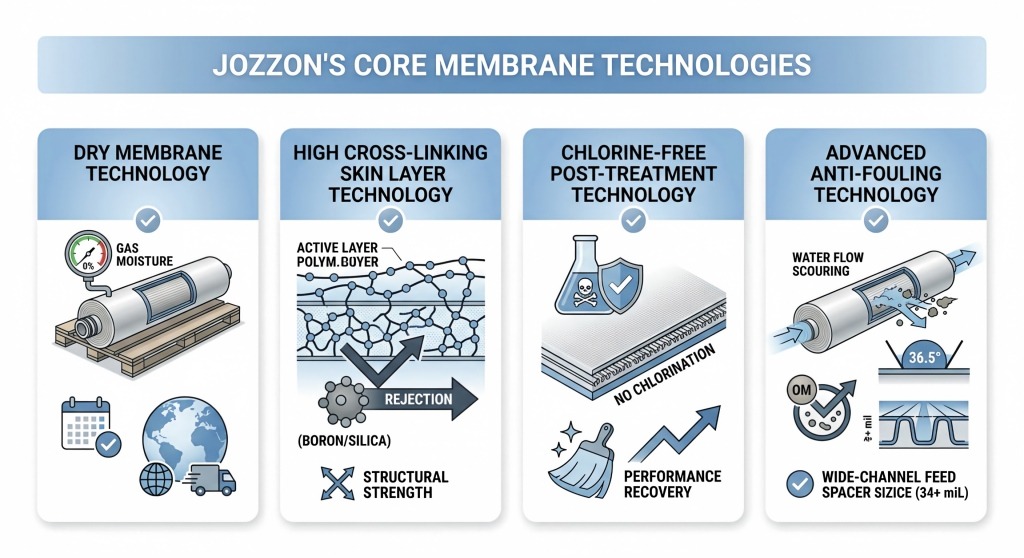
While the fundamental structure of a TFC membrane is well understood, the details of how each layer is formed and modified make all the difference in real-world performance. JOZZON has developed four core technologies that define the performance, durability, and reliability of our membrane sheets.
1. Dry Membrane Technology
Traditional RO membranes are shipped in a wet state, preserved in a solution that must be kept moist at all times to prevent the membrane from drying out and losing performance. This creates logistical challenges, increases shipping weight, and introduces risks of biological contamination during storage.
JOZZON’s dry membrane technology changes this paradigm. By using crystalline water between membrane leaves to maintain hydration, we produce membranes that can be stored and shipped in a dry state without compromising performance. The dry state is verified using gas-based integrity testing, ensuring that every membrane meets our strict quality standards.
The benefits are significant:
- Lower transportation costs due to reduced weight and simplified packaging.
- Extended shelf life, allowing for flexible inventory management.
- No preservatives or biocides, making the membrane more environmentally friendly and eliminating the need for post-shipment rinsing.
- Reduced environmental impact during storage and handling.
- This technology is particularly valuable for customers in remote locations or those who need to stock membranes for extended periods.
2. High Cross-Linking Skin Layer Technology
The performance of an RO membrane is ultimately determined by the quality of its polyamide active layer. JOZZON’s high cross-linking skin layer technology is built on an efficient carboxylic acid process, combined with proprietary additives and high-performance catalysts.
The result is a dense, highly cross-linked polyamide layer with exceptional salt rejection and stability. The reaction environment is carefully controlled to ensure consistent cross-linking density across the entire membrane surface, eliminating weak spots that could compromise performance.
This technology delivers:
- Higher salt rejection, particularly for challenging contaminants like boron and silica.
- Greater stability under varying operating conditions, including fluctuations in pH and temperature.
- Longer membrane life, as the robust cross-linked structure is more resistant to chemical degradation and mechanical stress.
3. Chlorine-Free Post-Treatment Technology
Many conventional RO membranes undergo a post-treatment process involving chlorination to improve performance and stability. However, chlorine is inherently damaging to polyamide membranes, and residual chlorine can accelerate membrane degradation over time.
JOZZON’s chlorine-free post-treatment technology replaces this chlorination step with alternative processes that achieve the same performance benefits without the drawbacks. The result is a membrane that is more resistant to oxidative degradation and maintains its rejection performance even after multiple cleaning cycles.
This is particularly important in applications where membranes are subjected to frequent cleaning, such as wastewater treatment or industrial process water production. With JOZZON’s chlorine-free membranes, operators can clean more aggressively without worrying about long-term performance loss.
4. Advanced Anti-Fouling Technology
Fouling is the single greatest challenge in RO operation. It increases energy consumption, reduces permeate quality, and shortens membrane life. JOZZON’s anti-fouling technology addresses this challenge at the molecular level.
During the interfacial polymerization reaction, we introduce hydrophilic, neutral-charge functional groups into the polyamide layer. These groups make the membrane surface more hydrophilic—meaning it attracts water rather than organic matter, proteins, or microorganisms.
The effectiveness of this technology is measured by the static contact angle. JOZZON’s membranes achieve a contact angle of just 36.5 degrees, compared to 43.5 degrees for conventional RO membranes. A lower contact angle indicates higher hydrophilicity, which translates directly to better fouling resistance.
The benefits of this technology are clear:
- Reduced fouling rate, leading to longer intervals between cleanings.
- Lower energy consumption, as less pressure is required to maintain permeate flow.
- Stable performance over the entire membrane lifespan.
The Spiral-Wound Element: Engineering for Practicality
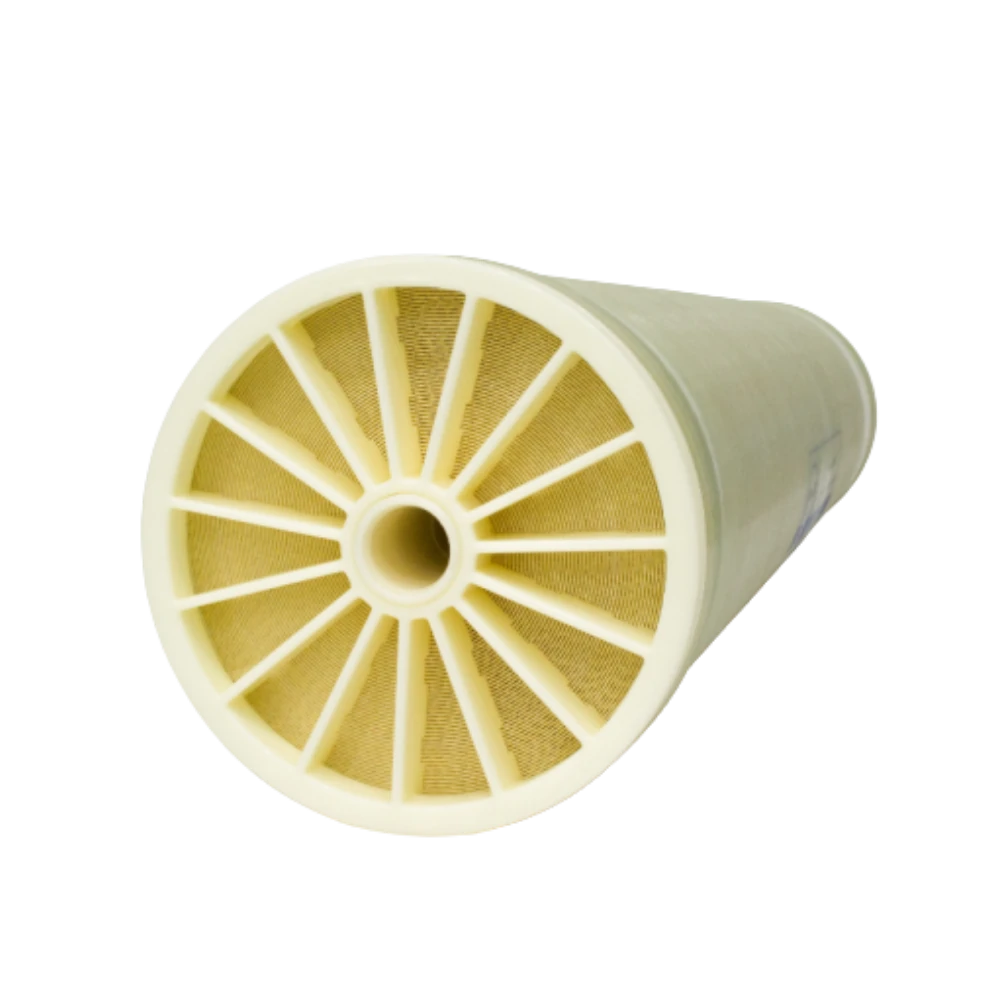
While the flat-sheet membrane is the fundamental unit, it is the spiral-wound element that makes RO practical for industrial-scale applications. In a spiral-wound element, flat membrane sheets are sandwiched between feed spacers and permeate carriers, then rolled around a central perforated tube.
This design maximizes the surface area available for separation within a compact footprint. Feedwater flows axially through the spacer channels, while permeate is collected in the permeate carrier and spirals inward toward the central tube. The result is a module that can process thousands of liters per hour while maintaining a manageable pressure drop.
The performance of a spiral-wound element depends on several design parameters, including:
- Feed spacer thickness and geometry: Determines the flow distribution and pressure drop across the membrane surface.
- Permeate carrier design: Influences the collection efficiency and pressure drop on the permeate side.
- Membrane leaf length and count: Affects the total surface area and the uniformity of flow distribution.
- Glue line patterns: Control the sealing and flow paths within the element.
At JOZZON, we take a different approach to manufacturing. The critical processes of gluing and rolling are entrusted to a production team with an average of more than ten years of hands-on experience, led by a production director with decades of expertise in membrane manufacturing. This human-centered craftsmanship ensures that every glue line is placed with care, every membrane leaf is aligned with precision, and every element is assembled with the attention to detail that only experienced hands can provide. The result is a membrane element with superior structural integrity and consistent performance.
Superior Fouling Resistance and High Flux: The JOZZON Advantage
Two of the most critical performance characteristics of any RO membrane are its resistance to fouling and its water flux. These two factors often exist in tension—membranes with higher flux tend to foul more quickly, while fouling-resistant membranes may sacrifice permeability. JOZZON has engineered its membranes to excel at both.
1. Advanced Fouling Resistance
Fouling is the enemy of membrane performance. It increases operating pressure, reduces permeate quality, and shortens membrane lifespan. JOZZON’s membranes incorporate advanced surface modification technologies that create a hydrophilic, low-fouling surface. This surface resists the adsorption of organic matter, proteins, and microorganisms, dramatically reducing the frequency of cleaning and extending the membrane’s service life.
The proprietary coating formulations used in JOZZON membranes are the result of years of research and development. They are designed to maintain their integrity even under harsh operating conditions, including high pH, elevated temperatures, and exposure to oxidizing agents. This means that JOZZON membranes can be used in a wider range of applications, from municipal wastewater treatment to industrial process water production, without compromising on performance.
2. High Flux Performance
High flux is essential for maximizing productivity and minimizing energy consumption. JOZZON’s membranes achieve industry-leading flux rates through a combination of optimized polyamide chemistry, precise control of the cross-linking density, and advanced surface modification.
The high cross-linked polyamide film density formulas used in JOZZON membranes create a thin, highly permeable active layer that allows water molecules to pass through rapidly while still rejecting dissolved salts and other contaminants. This translates to higher permeate flow at lower operating pressures, reducing energy costs and improving overall system efficiency.
Moreover, JOZZON’s manufacturing process ensures that the support layer and permeate carrier are optimized for minimal pressure drop, further enhancing flux performance. The result is a membrane that delivers exceptional productivity without sacrificing rejection or durability.
The Challenge of Concentration Polarization and Fouling
No discussion of RO membrane technology would be complete without addressing the challenges that arise during operation. Two phenomena are particularly important: concentration polarization and fouling.
1. Concentration Polarization
As water passes through the membrane, dissolved solutes accumulate at the membrane surface, creating a concentration gradient. This phenomenon, known as concentration polarization, results in a localized increase in solute concentration that can be significantly higher than the bulk feed concentration. The consequences include:
- Increased osmotic pressure: The higher solute concentration at the membrane surface increases the effective osmotic pressure, reducing net driving pressure and permeate flux.
- Enhanced fouling potential: The elevated concentration of sparingly soluble salts can lead to precipitation and scaling.
- Reduced rejection: In extreme cases, concentration polarization can cause solutes to diffuse through the membrane, reducing rejection efficiency.
Managing concentration polarization requires careful system design, including adequate crossflow velocity, turbulent flow promotion, and periodic cleaning.
2. Membrane Fouling
Fouling is the accumulation of unwanted material on the membrane surface or within its pores. It can be classified into several categories:
- Scaling: Precipitation of sparingly soluble salts, such as calcium carbonate, calcium sulfate, and barium sulfate.
- Organic fouling: Adsorption of natural organic matter, proteins, and polysaccharides.
- Biofouling: Growth of microorganisms and formation of biofilms.
- Colloidal fouling: Deposition of clay, silica, and other colloidal particles.
Fouling increases operating pressure, reduces permeate quality, and shortens membrane lifespan. Effective pretreatment, optimized operating conditions, and regular cleaning are essential for mitigating fouling and maintaining performance. JOZZON’s fouling-resistant membranes are designed to withstand these challenges, maintaining high performance even in demanding feedwater conditions.
What Sets JOZZON Membranes Apart?
JOZZON Membrane originated from the Space Science Center of the Chinese Academy of Sciences, and this heritage of precision and innovation is evident in every membrane we produce. Here are some of the key differentiators that set our membranes apart:
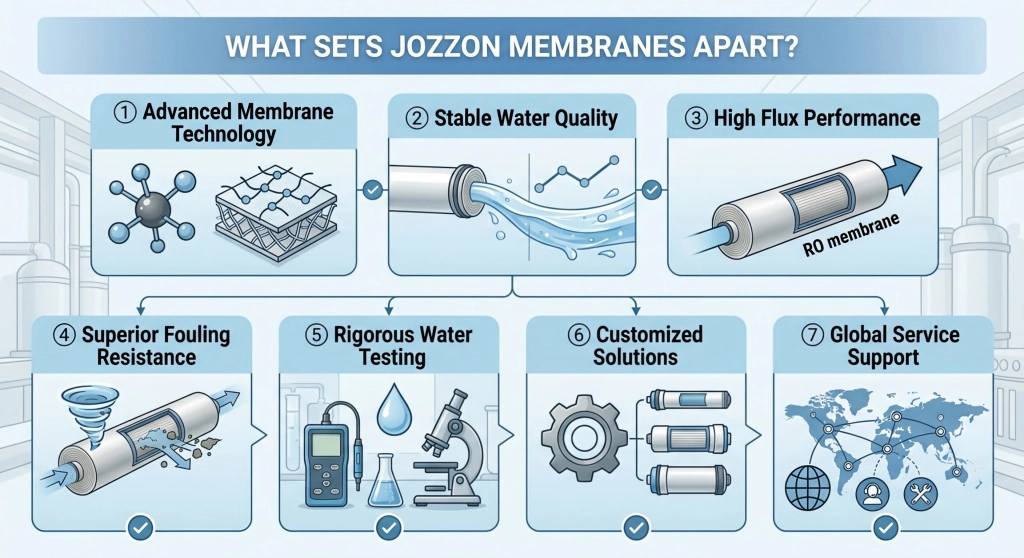
1. Advanced Membrane Technology
Our research and development team continuously pushes the boundaries of polymer science, developing proprietary formulations that deliver superior performance. We hold multiple patents on polymer water filtration layer technologies, and our membranes are engineered for optimal cross-linking density and surface chemistry.
2. Stable Water Quality
We source only top-grade raw chemical components and employ rigorous quality control at every stage of production. Our high cross-linked polyamide film density formulas ensure consistent rejection performance, even under challenging feedwater conditions.
3. High Flux Performance
Our membranes are engineered to deliver exceptional water flux without compromising rejection. Through optimized polyamide chemistry and precision manufacturing, we achieve high permeability that translates to lower energy consumption and higher productivity for our customers.
4. Superior Fouling Resistance
JOZZON’s proprietary surface modification technologies create a hydrophilic, low-fouling surface that resists the accumulation of organic matter, microorganisms, and scaling compounds. This extends membrane life, reduces cleaning frequency, and maintains stable performance over time.
5. Rigorous Water Testing Before Shipment
Every membrane batch undergoes comprehensive water testing before shipment. This real-world validation ensures that our membranes meet the highest standards of performance and reliability. We test for flux, rejection, and integrity, so our customers can be confident that their membranes will perform as expected from day one.
6. Customized Solutions
We offer customized solutions tailored to specific applications, including brackish water desalination, seawater desalination, landfill leachate treatment, and material separation. Our technical team works closely with customers to select the right membrane for their unique needs.
7. Global Service Support
With a global network of service centers and technical experts, we provide comprehensive support to our customers, including membrane selection, system design, installation, commissioning, and maintenance.
The JOZZON Membrane Excellent
At JOZZON, we often refer to the “Nine Chapters” of membrane technology—a framework that captures the essential elements of membrane design, manufacturing, and application. These nine chapters represent our holistic approach to membrane excellence:
- Material Science: Advanced polymer chemistry and formulation.
- Membrane Structure: Precision engineering of the active layer, support layer, and coatings.
- Element Design: Optimized spiral-wound geometry for maximum efficiency.
- Manufacturing Craftsmanship: Experienced hands and meticulous attention to detail.
- Performance Testing: Rigorous water testing and quality control.
- Application Engineering: Tailored solutions for diverse water treatment challenges.
- System Integration: Seamless integration with pretreatment, pumps, and controls.
- Operation and Maintenance: Best practices for long-term performance.
- Service and Support: Comprehensive technical assistance and after-sales service.
Each chapter builds on the others, creating a comprehensive framework for delivering membranes that perform reliably in the most demanding environments.
Conclusion: The Future of RO Membrane Technology
Reverse osmosis membrane technology has come a long way since its commercial introduction in the 1960s. Today’s membranes are more efficient, more durable, and more versatile than ever before. Yet the quest for improvement continues. Researchers are exploring new materials, such as graphene oxide and carbon nanotubes, that could revolutionize membrane performance. Advanced manufacturing techniques are opening new possibilities for membrane design.
At JOZZON, we are committed to staying at the forefront of this evolution. By combining deep expertise in polymer science, precision manufacturing, and application engineering, we deliver membranes that meet the toughest challenges in water treatment. Whether you are desalinating seawater, treating industrial wastewater, or producing ultrapure water for electronics manufacturing, JOZZON has the membrane solution you need.
For more information about our products and services, please visit our website or contact our technical team. We look forward to helping you achieve your water treatment goals.