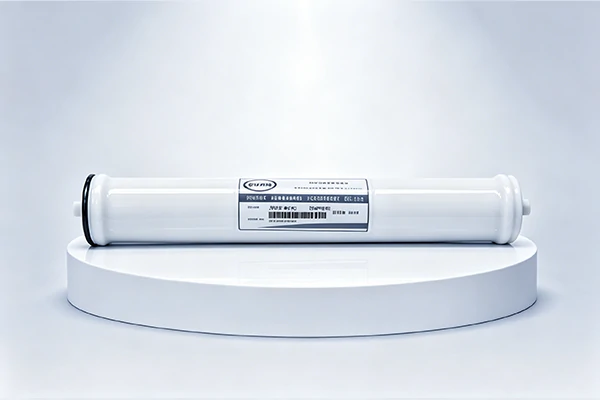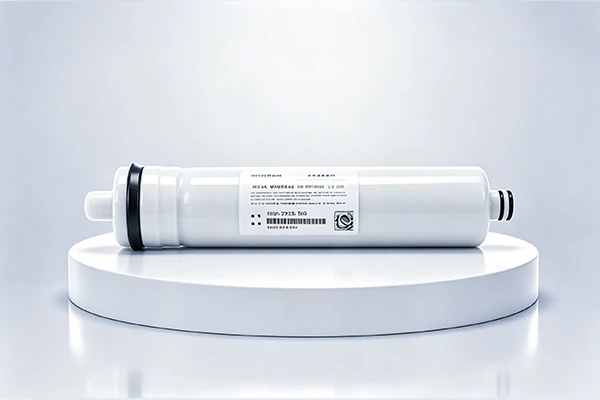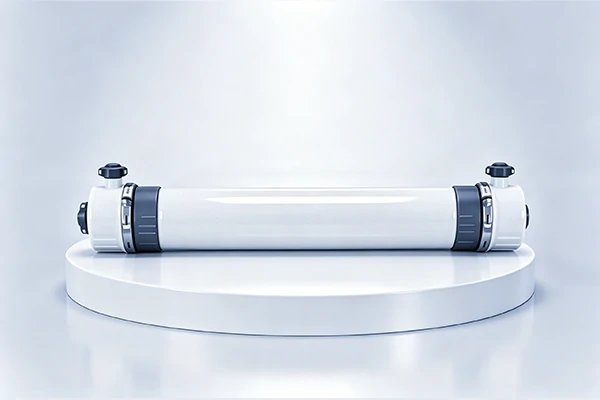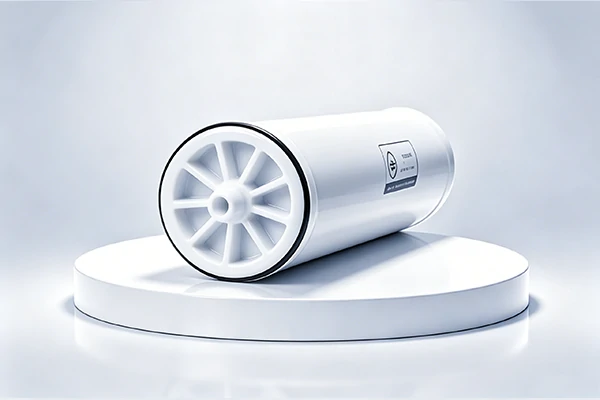
Colloidal particles are those with a diameter between 1 nanometer and 1 micrometer that are difficult to settle naturally. Colloidal fouling can severely affect the performance of reverse osmosis and nanofiltration elements, such as significantly reducing permeate flow and even decreasing the system’s desalination rate. The initial symptom of colloidal fouling is an increase in system pressure differential.
1. Assessment of Colloidal Contamination
The mainstream technique for determining the degree of colloidal fouling in reverse osmosis and nanofiltration feed water is to measure the Silting Density Index (SDI). It is an important indicator that needs to be measured before designing a pretreatment system, and it also needs to be monitored regularly during the daily operation of the system.
The SDI value measures the flow rate decrease when passing through a 47mm diameter membrane with a 0.45μm pore size. A 0.45μm pore size is chosen because at this pore size, colloidal substances are more likely to clog the membrane than hard particulate matter (such as sand, scale, etc.). The flow rate decrease is converted into a value between 1 and 100, which is the SDI value. The lower the SDI value, the less likely water is to foul and clog the membrane.
The method for determining the pollution index is specified in ASTM D4189-82, the American Society for Materials Science standard test method.
2. Methods for controlling colloidal contamination
(1) Media filtration
Media-based methods can remove particles, suspended solids, and colloids. When water flows through a filter media bed, particles, suspended solids, and colloids adhere to the surface of the filter media. The quality of the filtered water depends on factors such as the size, surface charge, and shape of the impurities and filter media, the composition of the raw water, and operating conditions.
The most commonly used filter media in water treatment systems are quartz sand and anthracite. The effective diameter of quartz sand particles in fine sand filters is 0.3–0.5 mm, while the effective diameter of anthracite particles in anthracite filters is 0.7–0.8 mm.
There are two main types of filters: gravity filtration and pressure filtration. They can also be classified by filtration rate as slow-flow filtration and rapid-flow filtration. For raw water with a high tendency to become polluted (such as surface water, contaminated well water, or wastewater), the filtration flow rate must be less than 10 m/h (generally 6 m/h) or a two-stage media filter should be used. For water bodies with low colloid content (groundwater), a higher filtration rate can be selected.
(2) Oxidation-filtration
Some well water is typically in a reduced state, characterized by the presence of divalent iron and manganese, and sometimes hydrogen sulfide and ammonia. When the oxygen content in the water exceeds 5 mg/L, Fe²⁺ will convert to Fe³⁺ , forming insoluble hydroxide colloidal particles. Oxidation-filtration is a treatment method for this type of water. The oxidation reactions of iron and manganese are as follows:
4Fe(HCO3)2 + O2 + 2H2 O ↔4Fe(OH)3 + 8 CO2
4Mn(HCO3)2 + O2 + 2H2O ↔4Mn(OH)3 + 8 CO2
Iron oxidation occurs at very low pH levels, making iron fouling more likely. Even with an SDI less than 5 and an iron content in the RO feedwater below 0.1 mg/L, iron fouling can still occur. Feedwater with lower alkalinity tends to have higher iron ion content because the solubility of FeCO3 limits the concentration of Fe2 + .
It is essential to prevent its contact with air and any oxidizing agents within the system. A low pH value is beneficial in delaying the oxidation of Fe²⁺ ; when pH < 6 and oxygen content < 0.5 mg/L , the maximum permissible Fe²⁺ concentration is 4 mg/L , or it can be treated with air or Cl₂ . KMnO4 , iron oxide , and manganese oxide are used to remove the resulting oxides through a media filter. An oxidant is added to the media filter to oxidize Fe2+ through electron transfer , thus completing the oxidation-filtration process in one step .
Ganoderma lucidum is a granular filter medium that can be regenerated by oxidation with KMnO4 when its oxidation capacity is depleted. After regeneration, the residual KMnO4 must be completely flushed away to prevent oxidative damage to the membrane. This treatment method can be used when the Fe2+ content in the raw water is less than 2 mg/L . If the Fe2+ content in the raw water is higher, KMnO4 can be continuously added before the filter inlet. However, in this case, measures such as installing an activated carbon filter must be taken to ensure that no potassium permanganate enters the membrane element.
Birm filtration can also be effectively used to remove Fe²⁺ from RO /NF feed water . Birm is a filter medium coated with manganese dioxide on an aluminosilicate matrix. It catalyzes the reaction between dissolved oxygen and ferrous iron, causing soluble ferrous iron and manganese to precipitate. These precipitates can be flushed out of the filter by backwashing. Because the pH will increase during this process, LSI changes may occur , so it is important to prevent the formation of CaCO₃ precipitates in the filter and RO/NF system .
(3) Flocculation-coagulation aid
Flocculation is achieved by adding flocculants to neutralize the surface charge of colloidal particles, making it easier for the colloidal particles to aggregate. When the raw water has a high suspended solids content and a high SDI, a traditional coagulation-coagulation aid process can be used. The resulting flocs grow and settle in a specially designed reaction space, and are discharged as sludge. The supernatant is then further treated in a multi-media filter.
(4) Microfiltration or ultrafiltration
Microfiltration (MF) or ultrafiltration (UF) can remove all suspended solids. Depending on the molecular weight of the organic matter and the membrane’s molecular weight cutoff, ultrafiltration can also remove some organic matter. If designed and operated properly, the solid-liquidity index (SDI) can be less than 1. In this case, the fouling problem is transferred from the RO/NF membrane to the MF or UF membrane and handled by the microfiltration or ultrafiltration system. If the microfiltration and ultrafiltration membrane materials are chlorine-resistant, such as polysulfone or ceramic membranes, chlorination should also be added to the cleaning water to prevent biofouling.
(5) Design and operation scheme
Preventing colloidal contamination requires not only appropriate pretreatment techniques but also reasonable system design and operation.
To reduce pretreatment burden, use water sources with better quality whenever possible. The water intake for surface water and seawater treatment systems is crucial; contamination of the raw water by wastewater discharge will cause serious operational problems for the RO/NF system. Ideally, water should be drawn from deep wells near the coast and rivers. If open surface intake is necessary, it should be as far away from the bank as possible and the intake should be several meters below the water surface. Newly built wells will release suspended solids in the first few days; proper cleaning is necessary beforehand. Additionally, non-corrosive materials should be used to construct the system whenever possible.