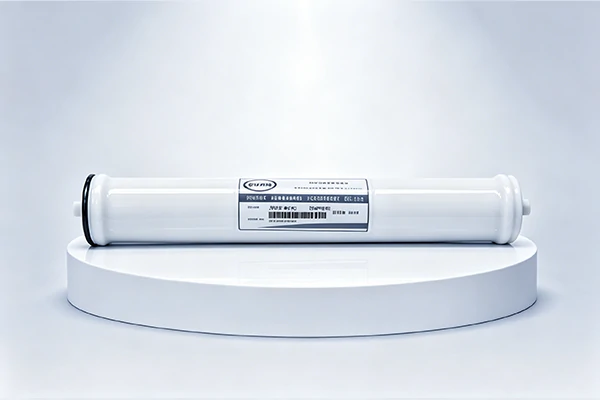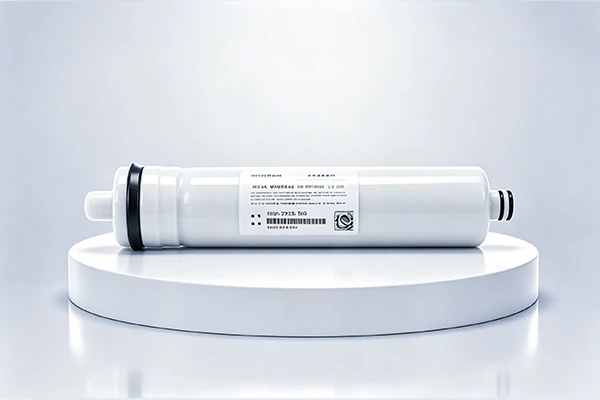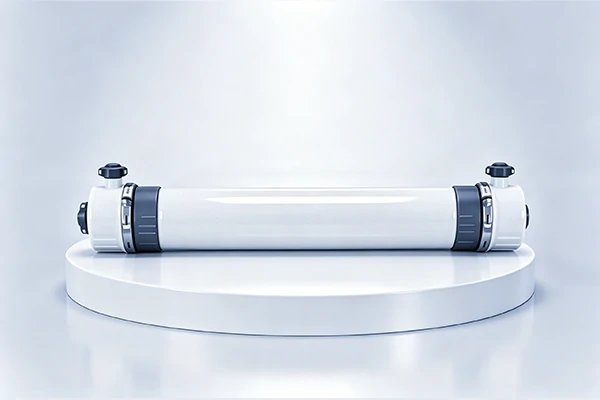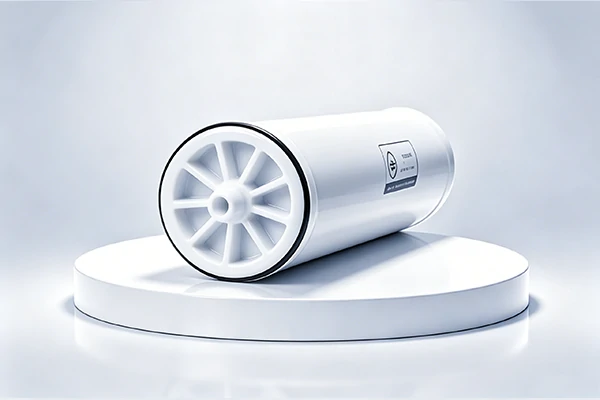
When a problem occurs in the membrane system, first rule out factors outside the membrane, such as insufficient water supply from the raw water pump, reduced pressure of the high-pressure pump, increased pressure drop of each filter, and opening of pipeline bypasses or sewage discharge, etc. Such situations should be dealt with promptly.
If a problem is confirmed with the membrane, the machine should be stopped immediately, a membrane should be removed and carefully inspected to identify the problem and address it accordingly. The specific steps are as follows:
1. Membrane element problem diagnosis
(1) Check whether the membrane element housing is intact and undamaged. In some systems, the membrane element may rupture when it is severely blocked or when there are drastic changes in water supply pressure.
(2) Check whether there are foreign objects such as mud and sand on the membrane element housing and end cap at the water inlet. If so, it indicates that the pretreatment is not completely removing particulate matter. The pretreatment system (multi-media filter) should be checked and improved in time.
(3) Check for deposits at the concentrate end of the membrane element. If there are obvious white granular deposits at the concentrate end of the membrane element, it can be determined as inorganic salt scaling and pollution, indicating that the LSI ( Langriller saturation index ) of the feed water is greater than 0, the water has a tendency to produce calcium carbonate deposits, or the scale inhibitor is malfunctioning, and the system is at risk of scaling.
(4) Red deposits are present at the inlet and concentrate ends of the membrane element, the desalination rate and water production decrease, and the system pressure drop increases, which is due to metal oxide/hydroxide pollution.
(5) If there are viscous pollutants at the inlet of the membrane element and the water production is significantly reduced, it indicates colloidal or microbial contamination. Microscopic examination or colony culture can be used to distinguish whether it is colloidal or microbial contamination.
2. Solution
Membrane contaminants can be classified into the following categories:
(1) Inorganic pollutants are classified into carbonate precipitates, sulfate precipitates, metal oxide/hydroxide precipitates and other inorganic salt precipitates.
(2) Colloidal precipitation
(3) Organic pollution
(4) Microbial contamination
The specific solution is as follows:
2.1 Carbonate precipitation
(1) Common components: carbonates of metal ions such as Ca, Mg, Ba, and Sr.
(2) Causes of pollution:
- Scale inhibitor/dispersant addition system malfunction;
- The acid addition pH adjustment system malfunctioned;
- The ion exchange resin is not regenerated in a timely manner;
- The recovery rate is controlled too high
(3) Cleaning solution:
Use a 2% citric acid solution, adjust the pH to 4 with ammonia, and control the cleaning temperature at 40℃; for more severe contamination, use a 2.0% hydrochloric acid aqueous solution with a pH of 2-3 for cleaning.
(4) Cleaning steps:
- Rinse with water using the reverse osmosis membrane product;
- Prepare a cleaning solution using reverse osmosis membrane product water, accurately weigh and mix it evenly, and check whether the pH of the cleaning solution meets the requirements.
- Introduce the cleaning solution into the reverse osmosis system at a low pressure using the normal cleaning flow rate, and begin the return water discharge to prevent the cleaning solution concentration from decreasing. Circulate for 15 minutes, observe the turbidity of the return water, and check the pH value. If it becomes significantly turbid or the pH change exceeds 0.5, continue adding chemicals to maintain the pH of the cleaning solution.
- Stop the circulation and soak for 1 hour;
- Clean at high flow rate (1.5 times the normal flow rate) for 15 minutes. At this time, care should be taken not to make the pressure too high, and the system should be limited to producing water pressure.
- Rinse the system with reverse osmosis membrane product water until the cleaning solution is completely flushed out and no residue remains. Turn on the system, check the cleaning effect, and then discharge the produced water.
2.2 Metal oxide/hydroxide precipitation
(1) Common components: oxides or hydroxides of Fe, Mn, Cu, Zn, etc.
(2) Cause of pollution:
- Equipment, pipelines, containers, etc., are corroded;
- Iron or aluminum filter aids are used in the pretreatment filtration system.
(3) Cleaning solution:
Use a 3% sodium bisulfite solution, adjust the pH to 4 with ammonia, and control the cleaning temperature at 40℃. Alternatively, a 2% hydrochloric acid solution with a pH of 2-3 can be used for cleaning.
(4) Cleaning steps: Same as the carbonate cleaning method.
2.3 Sulfate precipitation or other inorganic salt precipitation
(1) Common components: sparingly soluble salts of metal ions such as Ca, Mg, Ba, Sr, etc., such as sulfates, fluorides, phosphates, silicates, etc.
(2) Causes of pollution:
- Scale inhibitor/dispersant addition system malfunction;
- The acid addition pH adjustment system malfunctioned;
- The ion exchange resin is not regenerated in a timely manner;
- The recovery rate was controlled too high.
(3) Cleaning solution:
A solution of 0.1% sodium hydroxide + 1.0% tetrasodium EDTA, pH controlled at 12, temperature at 30℃, can also be used; a solution of 0.1% sodium hydroxide + 0.5% tetrasodium EDTA + 0.5% sodium tripolyphosphate can also be used.
(4) Cleaning steps:
- Rinse with water using the reverse osmosis membrane product;
- Prepare a cleaning solution using reverse osmosis membrane product water, accurately weigh and mix it evenly, and check whether the pH of the cleaning solution meets the requirements;
- Input the cleaning solution into the reverse osmosis system at a low pressure using the normal cleaning flow rate, and begin the return water discharge to prevent the cleaning solution concentration from decreasing. Circulate for 15 minutes, observe the turbidity of the return water, and check the pH value. If it is significantly turbid or the pH change exceeds 0.5, continue to add reagents to maintain the pH of the cleaning solution;
- Stop the circulation and soak for 1 hour;
- High-flow cleaning (1.5 times the normal flow rate) for 30-60 minutes. At this time, care should be taken not to make the pressure too high, and the system should be limited to producing water pressure.
- Rinse the system with reverse osmosis membrane product water until the cleaning solution is completely flushed out and there is no residue. Turn on the system to run, check the cleaning effect, and then discharge the produced water.
When inorganic salt contamination occurs, it can be initially treated as carbonate contamination. If the performance of the membrane element does not change significantly before and after cleaning, it can be determined to be sulfate or other inorganic salt contamination. Sulfate and certain inorganic salt contaminations are extremely difficult to clean, and the cleaning effect is generally not obvious. In such cases, appropriate equipment should be designed in the pretreatment process, such as antiscalant addition, softening, and ion exchange resin, to prevent the membrane element from being re-contaminated.
2.4 Colloid pollution
(1) Common components: iron, aluminum, silicon, or organic matter.
(2) Cause of contamination: Pretreatment failed to completely remove contaminants.
(3) Cleaning solution:
Use a 2% sodium tripolyphosphate solution, adjust the pH to 10 with sulfuric acid, and clean at 40°C; alternatively, use a sodium hydroxide solution with pH < 10 at 40°C.
(4) Cleaning steps: Same as the cleaning steps for sulfate contamination.
2.5 Organic pollution and microbial pollution
(1) Common components: humic substances, organic acids, etc.
(2) Causes of pollution: Decomposition of nutrients in surface water, deep well water, wastewater, and seawater.
(3) Cleaning solution:
Use a 2% sodium tripolyphosphate + 0.8% tetrasodium EDTA solution at pH 10 and a cleaning temperature of 40°C. In severe cases, use a 2% sodium tripolyphosphate + 0.25% surfactant (sodium dodecylbenzenesulfonate) solution at pH 10 and a cleaning temperature of 40°C.
2.6 Oxidized materials, oxide film elements
- Common components include sodium hypochlorite, residual chlorine, ozone, and potassium permanganate.
- Cause of contamination: Pretreatment failed to completely remove it.
In this case, the membrane layer is oxidized, and the membrane element must be replaced.