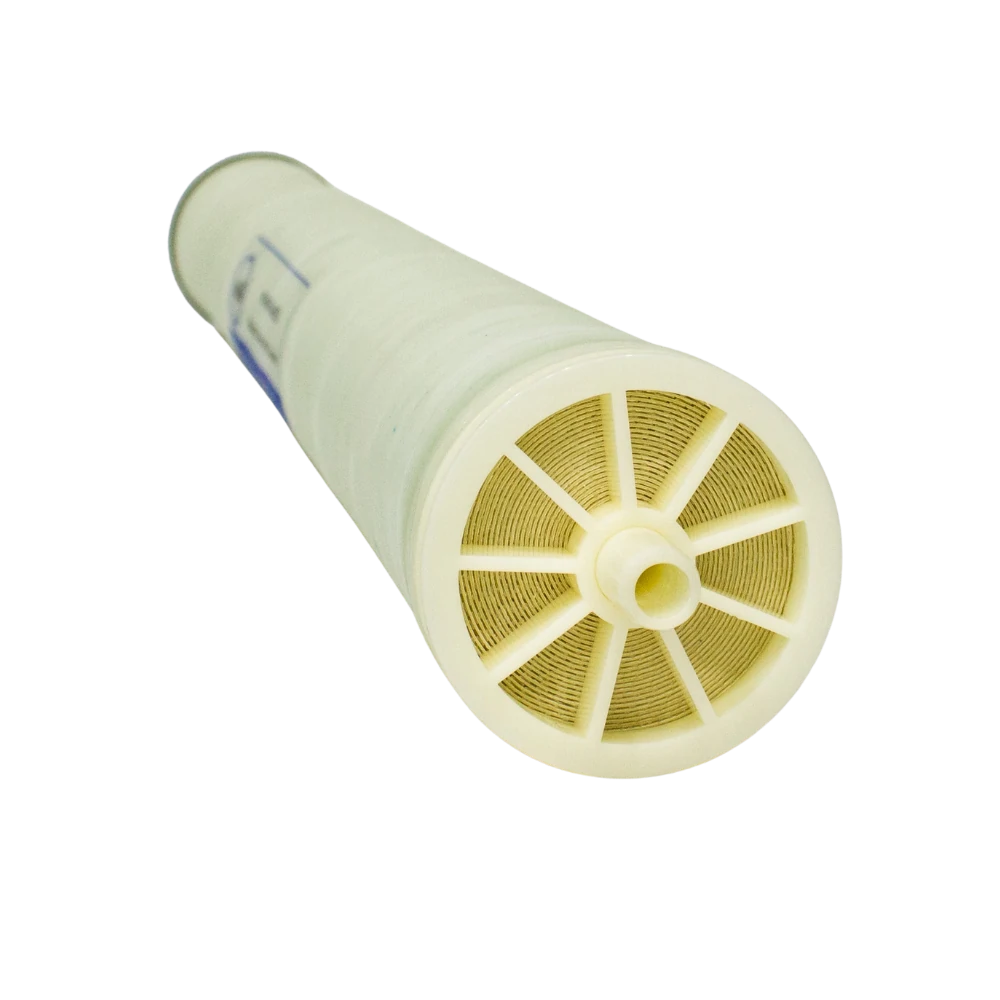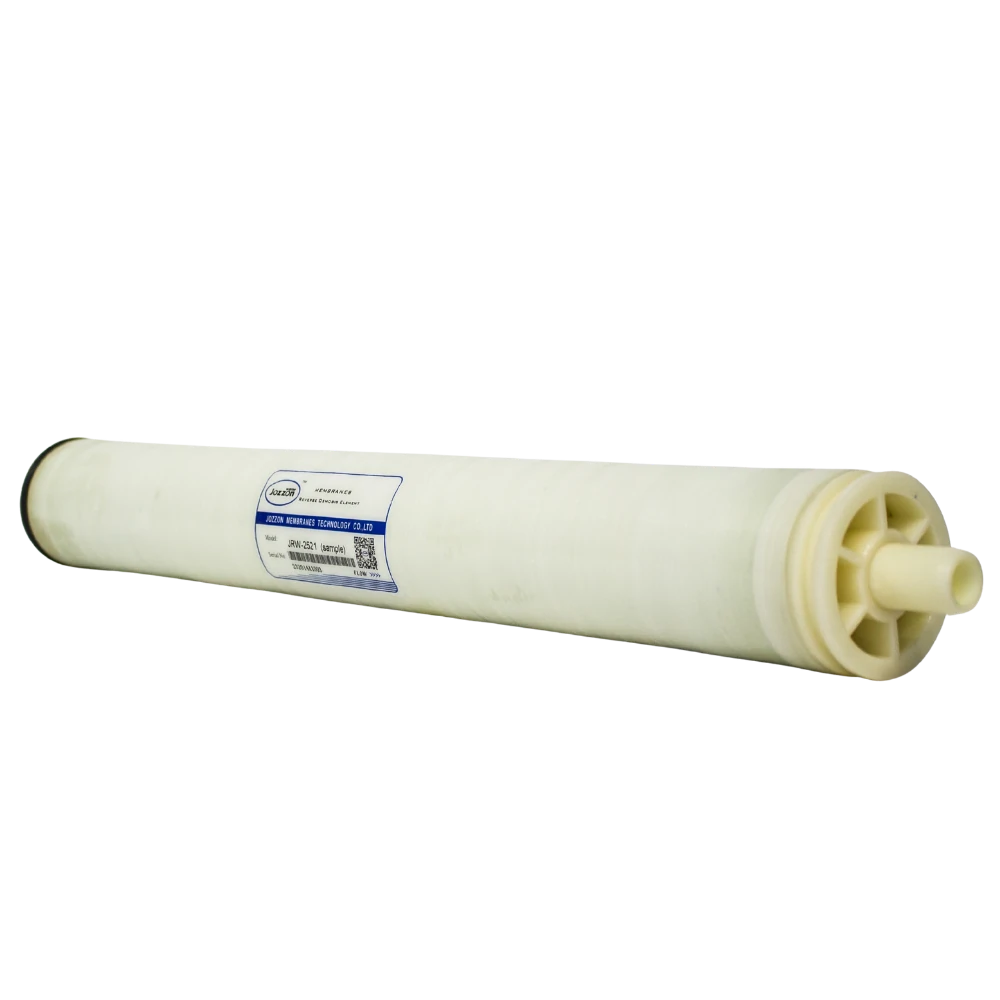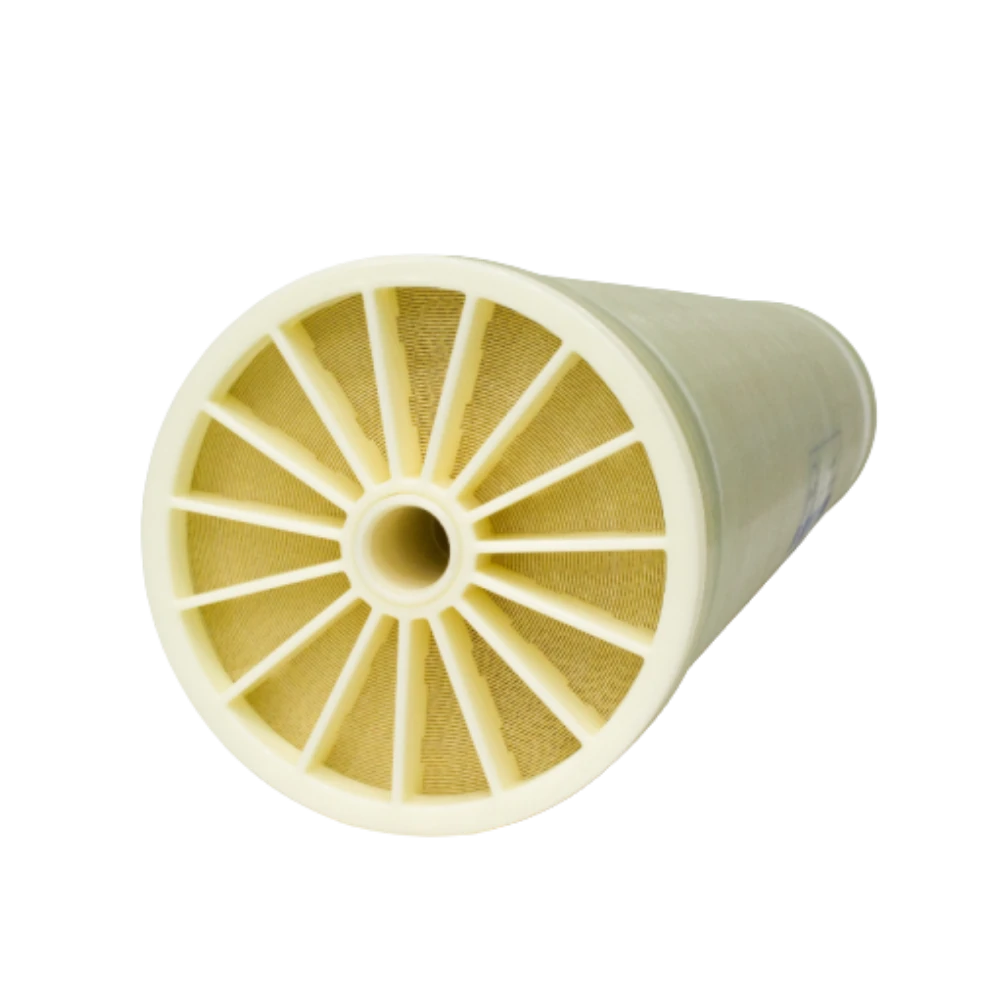
Reverse osmosis (RO) is the world’s leading membrane technology for producing high-quality purified water. From drinking water systems and seawater desalination plants to pharmaceutical manufacturing and semiconductor production, reverse osmosis membranes play a vital role in removing dissolved contaminants that conventional filtration cannot eliminate.
But how reverse osmosis membrane works is still one of the most frequently asked questions among engineers, plant operators, and homeowners alike.
The answer lies in a sophisticated membrane separation process that combines hydraulic pressure, selective diffusion, and a semi-permeable membrane to separate pure water from dissolved salts and impurities.
In this guide, you’ll learn the reverse osmosis membrane working principle, understand the RO membrane working process, and discover exactly how does reverse osmosis filtration work from feed water to purified permeate.
What Is a Reverse Osmosis Membrane?
A reverse osmosis membrane is a thin, semi-permeable membrane that allows water molecules to pass while rejecting most dissolved salts, organic compounds, microorganisms, and other contaminants.
Unlike conventional filters that rely primarily on pore size, an RO membrane separates substances through a solution-diffusion mechanism. Water molecules dissolve into the membrane’s dense polymer layer and diffuse across it, while larger or electrically charged contaminants are rejected.
Most industrial membranes are manufactured as thin-film composite (TFC) polyamide membranes, offering excellent chemical resistance, high water permeability, and salt rejection rates exceeding 99% under proper operating conditions.
Reverse Osmosis Membrane Working Principle
Understanding the reverse osmosis membrane working principle begins with understanding natural osmosis.
What Is Osmosis?
Osmosis is the natural movement of water through a semi-permeable membrane from a solution with lower dissolved solids to one with higher dissolved solids.
For example: Fresh Water → Salt Water
Water naturally flows toward the higher salt concentration until both sides reach equilibrium.
What Is Reverse Osmosis?
Reverse osmosis reverses this natural process.
Instead of allowing water to flow naturally, a high-pressure pump applies pressure greater than the solution’s osmotic pressure. This pressure forces water molecules to move in the opposite direction—from the concentrated solution to the purified side—while dissolved contaminants remain behind.
As a result, the system produces:
- Permeate: purified water
- Concentrate (reject): contaminants removed from the feed water
This pressure-driven separation is the foundation of modern RO filtration technology.
RO Membrane Working Process: Step by Step
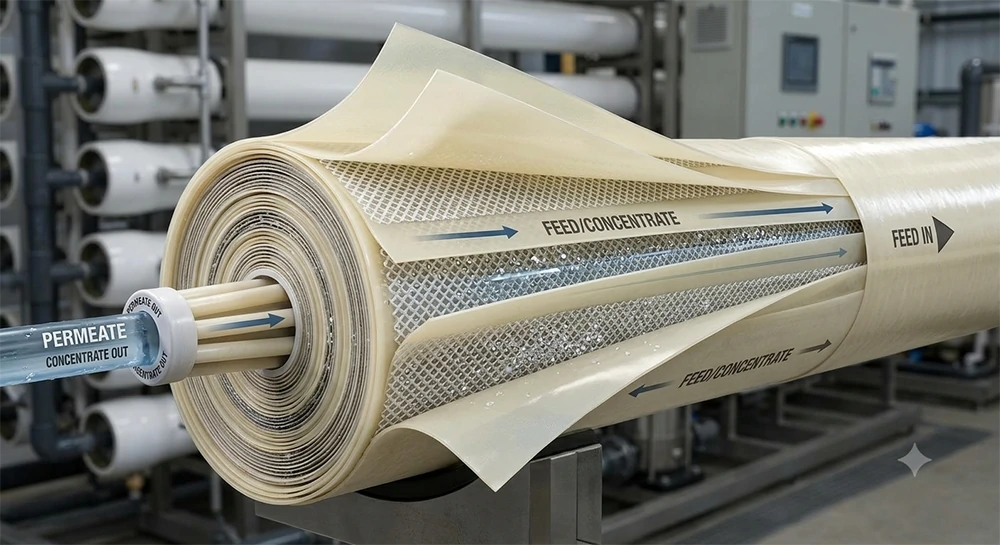
Understanding the RO membrane working process becomes easier when following the water through an industrial RO system. In commercial applications, an RO element is constructed as a tightly packed, spiral-wound module. This design wraps flat membrane sheets, feed spacers, and permeate collection layers around a central core to maximize surface area. Here is the exact step-by-step breakdown of how does RO membrane filter water inside that module:
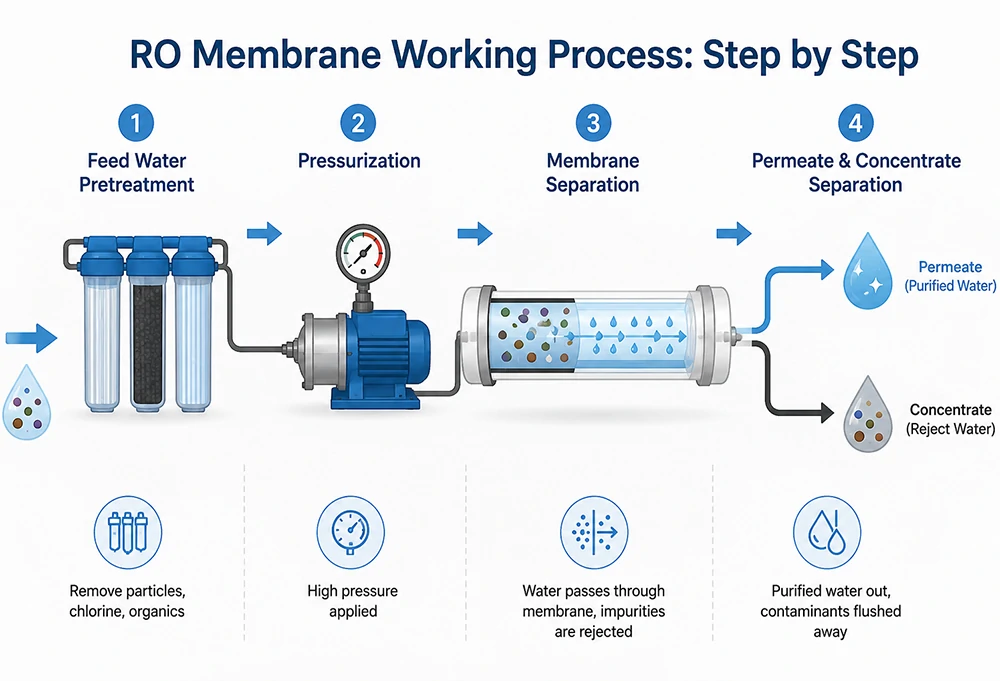
Step 1: Feed Water Pretreatment
Before entering the membrane, raw water is pretreated to protect the membrane from fouling and oxidation.
- Pretreatment commonly includes:
- Multimedia filtration
- Activated carbon filtration
- Cartridge filtration
- Water softening or antiscalant dosing
- Dechlorination
Proper pretreatment significantly extends membrane service life.
Step 2: Pressurization
A high-pressure pump raises the feed water pressure above its osmotic pressure.
Typical operating pressures are:
|
Feed Water Source |
Typical Operating Pressure |
|
Municipal Water |
8–15 bar |
|
Brackish Water |
10–25 bar |
|
Seawater |
55–80 bar |
Higher salinity requires higher operating pressure because osmotic pressure increases with dissolved salt concentration.
Step 3: Membrane Separation
This is where the reverse osmosis membrane mechanism occurs.
Inside the spiral-wound membrane element, feed water flows tangentially across the membrane surface rather than directly into it. This cross-flow design minimizes fouling while maintaining stable performance.
The dense polyamide membrane allows water molecules to diffuse through its polymer structure while rejecting: sodium, chloride, calcium, magnesium, heavy metals, organic compounds, bacteria, and viruses.
This highly selective membrane separation process enables reverse osmosis systems to produce exceptionally pure water.
Step 4: Permeate and Concentrate Separation
The incoming feed stream is divided into two separate flows.
Permeate: Permeate is the purified product water that passes through the membrane. It contains dramatically reduced levels of dissolved solids and contaminants.
Concentrate: Concentrate (also called reject or brine) carries away the contaminants rejected by the membrane. Maintaining continuous concentrate flow helps reduce scaling and membrane fouling.
How Does RO Membrane Remove Salt?
One of the most common questions is how does RO membrane remove salt.
Salt dissolves into positively and negatively charged ions. These hydrated ions are significantly larger and less mobile than water molecules.
The membrane rejects these ions through several mechanisms:
- Dense polymer structure
- Solution-diffusion transport
- Electrostatic interactions
- Hydrated ion exclusion
Because water molecules diffuse much more readily through the membrane than dissolved ions, salts remain on the feed side and are discharged with the concentrate stream.
Modern industrial RO membranes typically achieve:
- 95–99.8% salt rejection
- 99% bacteria removal
- 99% virus removal
- Excellent heavy metal removal
How Does Reverse Osmosis Filtration Work Compared with Traditional Filtration?
Many users ask how does reverse osmosis filtration work differently from conventional filtration technologies.
|
Technology |
Primary Function |
|
Sediment Filter |
Removes sand, rust and suspended particles |
|
Activated Carbon |
Removes chlorine, taste and odor |
|
Ultrafiltration |
Removes bacteria and colloids |
|
Reverse Osmosis |
Removes dissolved salts, heavy metals, microorganisms and many dissolved organics |
Unlike ordinary filters, reverse osmosis removes dissolved ions rather than only suspended particles.
Factors That Dictate RO Performance
An RO system’s real-world efficiency isn’t static; it is heavily influenced by several critical operating parameters:
- Feed Water Quality & Fouling: Higher concentrations of dissolved solids demand higher pressures. Accumulated scale, biological slime, or organic matter on the membrane surface creates fouling, which drops production and requires aggressive chemical cleaning.
- Operating Pressure: Running a system with insufficient pressure directly lowers salt rejection rates and drastically reduces clean permeate flow.
- Water Temperature: Warmer water increases the permeability of the polymer matrix, raising production rates. Cold water increases viscosity, slowing down the diffusion process.
- Concentration Polarization: As salts accumulate near the membrane surface, local osmotic pressure increases, reducing system efficiency. Proper cross-flow velocity helps minimize this effect.
- Membrane Fouling: Common fouling includes calcium carbonate, scaling, biofouling, organic fouling, and colloidal fouling. Routine cleaning and proper pretreatment are essential for maintaining performance.
- Membrane Age: Even with perfect maintenance, membranes age over several years, leading to a slow decline in salt rejection. Most industrial elements maintain an operational lifespan of 3 to 7 years depending on pretreatment quality.
Why Modern Element Design Incorporates Wide Feed Channels
Because RO elements handle highly concentrated mineral streams, they face constant scaling threats from calcium, magnesium, and sulfate ions. Modern industrial designs mitigate this by integrating wide feed flow channel spacers (such as 34 mil spacers). This wider spacing disrupts concentration polarization at the membrane boundary, optimizes cross-flow velocity, limits cleaning frequency, and ensures a stable lifespan even in harsh wastewater or deep mine water concentration setups.
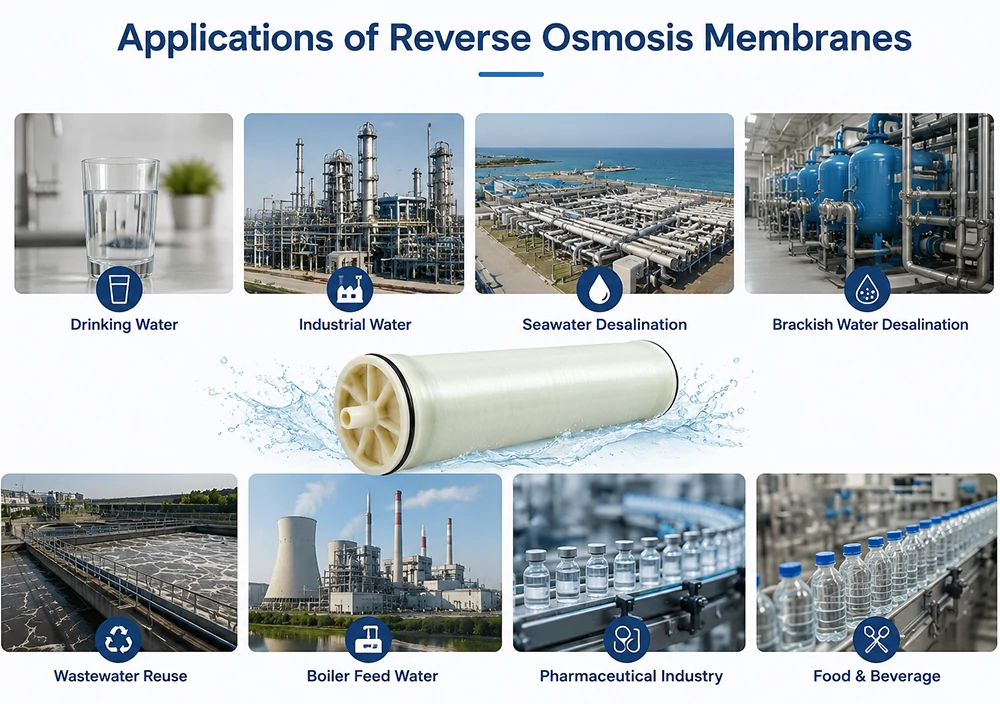
Applications of Reverse Osmosis Membranes
Because of their high contaminant rejection, reverse osmosis membranes are used in a wide range of industries.
Typical applications include:
- Drinking water purification
- Industrial process water
- Boiler feed water treatment
- Seawater desalination
- Brackish water desalination
- Wastewater reuse
- Pharmaceutical water systems
- Food and beverage processing
- Semiconductor ultrapure water production
Conclusion
Understanding how reverse osmosis membrane works is essential for selecting the right water treatment solution. The reverse osmosis membrane working principle relies on hydraulic pressure and a semi-permeable thin-film composite membrane to separate pure water from dissolved contaminants through an advanced membrane separation process.
Whether you’re researching how does RO membrane filter water, exploring the reverse osmosis membrane mechanism, or learning how does reverse osmosis filtration work, the process remains the same: pressure forces water molecules through the membrane while dissolved salts, heavy metals, microorganisms, and other impurities are rejected.
Thanks to its outstanding purification performance, RO filtration has become the preferred technology for drinking water treatment, industrial water purification, wastewater reuse, and seawater desalination around the world.